


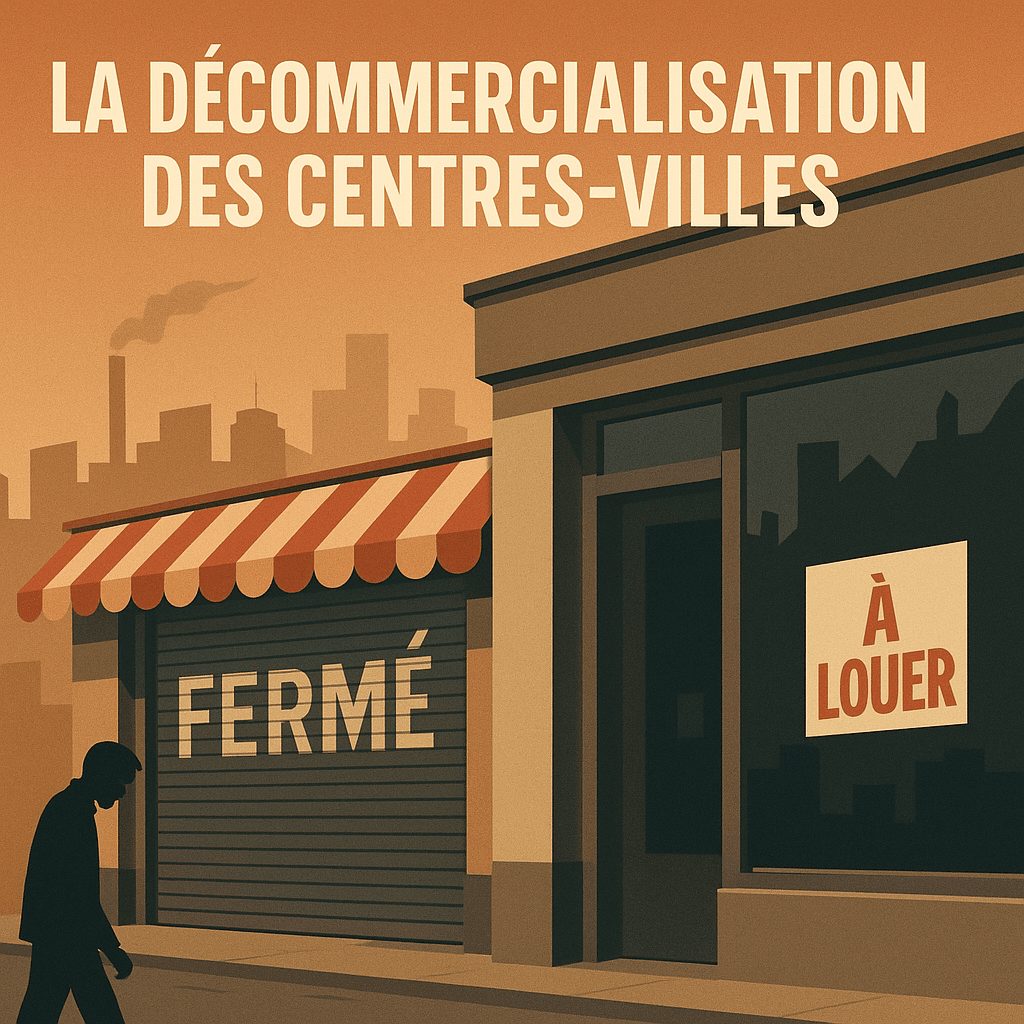
One figure is chilling to begin with. Codata, a company specialising in commercial property data collection, revealed a worrying indicator last July: in 20 years, the share of vacant shops in town centres has simply doubled in the 390 municipalities of more than 15,000 inhabitants examined in the study. From a vacancy rate of 5.94% in 2004, it has now risen to 10.85% in 2024.
The phenomenon has many causes, hence the complexity of solving the equation to stem this creeping desertification of town centres. The first factor is urban sprawl, which has kept growing in recent years, with out-of-town retail zones springing up continually despite some stricter regulatory texts. In 2020, Procos, the trade federation for specialist retail, noted that the 1,500 zones of this kind identified in France accounted for 75% of French people's in-store spending.
To this was added the explosion of e-commerce. The Covid-19 health crisis and the lockdowns clearly boosted online consumption at the expense of physical shops on town-centre high streets. This paradigm shift coincided with the urban transformations carried out by many town halls, such as more pedestrianised streets, the roll-out of trams and buses, the scarcity of parking spaces (even car parks) and higher hourly charges, not to mention the road congestion at peak hours that is no longer specific to very large cities such as Paris, Lyon or Marseille. For people in the outskirts and in rural areas, the town centre has thus become less and less accessible.
Finally, the coup de grâce for local shops comes from the constant rise in commercial leases. From a base of 100 in 2008, the Insee index has now reached 134.4 in 2024. For small shops, making ends meet is inevitably becoming ever harder, especially as energy costs have also jumped since the outbreak of the war in Ukraine and added to the bill. Shutters coming down has become so widespread that the decommercialisation of town centres is an established phenomenon. The whole political spectrum is represented, from the Rassemblement national to La France insoumise, taking in the Droite républicaine, the Union centriste and the socialist groups. Paradoxically, it turns out that the ecologists are the most discreet on this theme.
The parliamentarians mobilised against decommercialisation
The good news is that elected officials in the National Assembly and the Senate are taking up the subject, even if it is sometimes a matter of a territorial micro-issue or a sector-specific concern. Since the start of the current parliamentary term, 65 amendments have been tabled in the context of various bills and 34 questions have been asked. Unsurprisingly, the most frequently addressed recipients are the Ministry of the Economy and the Ministry of Commerce, Crafts, SMEs and the Social and Solidarity Economy. The themes vary. They range from the impact of the delivery company Mondial Relay's withdrawal from the parcel collection points offered by shopkeepers, to the impact of online commerce on those same shopkeepers, via the more frequent closures of newsagents and hairdressing salons, or even the penalty for bakers who make their employees work on 1 May!
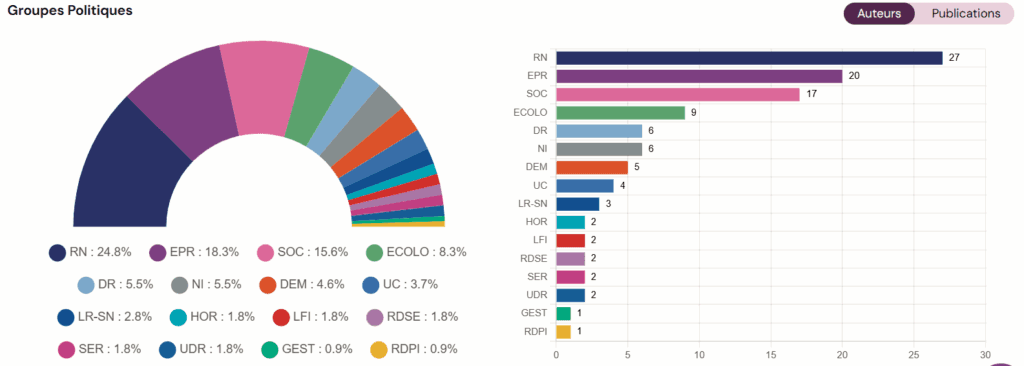
Another observation highlighted by the societal intelligence platform Follaw: questions and amendments come from all political groups and all regions, including Parisian elected officials such as LR senator Catherine Dumas, who asks about the worrying decline in butchers and delicatessens in Paris. Nevertheless, the subject of decommercialisation is heavily pre-empted by the Rassemblement national (24.8% of interventions), followed by Ensemble pour la République (18.3%) and the Parti socialiste (15.6%). Finally, note the significant lobbying activity of the chambers of commerce and of professional organisations and federations, with 32 actors counted.
Private members' bills in the pipeline
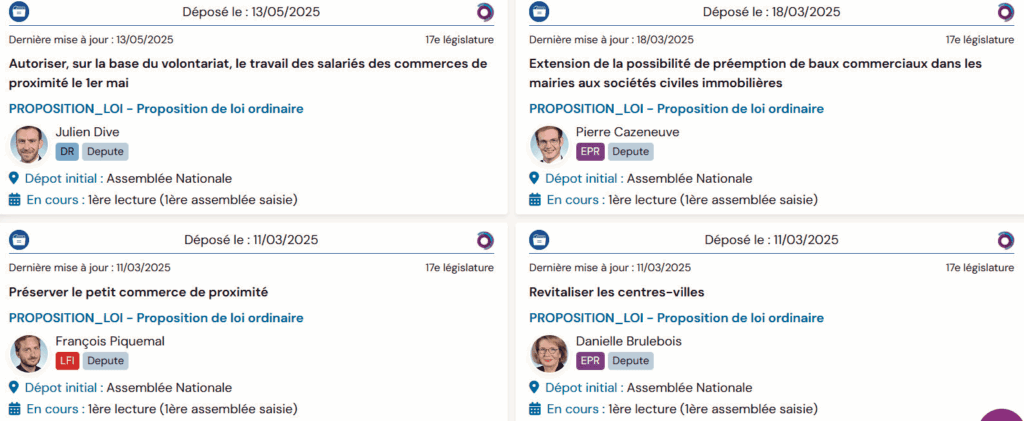
Beyond the debates on the floor of the chambers, four private members' bills have been at first reading in the National Assembly since March and May 2025. Two of them deal precisely with decommercialisation: the text carried by Danielle Brulebois (EPR) on revitalising town centres and the one defended by François Piquemal (LFI) on preserving small local shops. Their eventual adoption is admittedly more uncertain in terms of the parliamentary agenda, given the fragility of the current government.
However, the information report filed on 26 June by MPs Sandra Marsaud (EPR) and Julien Gokel (PS) on the evaluation of the Cœur de Ville programme maintains the momentum in the fight against decommercialisation. Launched in 2018, the programme now benefits 243 medium-sized towns and had mobilised €11.5 billion by the end of 2024 in grants, loans and investments.
Continuing the Cœur de Ville programme
Although the two MPs indicate that it has not always been easy to assess the programme, their conclusions indicate that it has been an “accelerator” of many projects and a tool unanimously praised by local elected officials themselves. They therefore call for it to be extended beyond 2026, in particular by opening a reflection on the place of medium-sized towns.
A reason for hope? The 2025 edition of the Observatoire de la Proximité (ObSoCo), published at the end of September, shows that footfall in local shops remains high nonetheless. A majority of French people visit them every week, often to combine convenience and quality, despite an offer judged incomplete, sometimes higher prices, restricted opening hours and a weak digital presence. Not to mention territorial divides to be bridged, depending on the département. Enough to feed parliamentarians' activity ahead of the next deadlines.