


Many rumours emerged during the presidential election. It is therefore worth asking which communities are at work in spreading them. As in my investigations into the rumour of Macron being funded by Saudi Arabia and the one around Cahuzac and Macron, it is very difficult to isolate the origin of a rumour. The only option open to us is to look at the accounts that spread them. After a fairly thorough examination, we can say that the rumours are mainly spread by accounts from the “patriosphere”, a set of actors bringing together supporters of Nicolas Sarkozy, Marine Le Pen, François Fillon and what is known as the “cathosphere”. Analysis with Visibrain.
I. Methodological introduction.
I isolated the rumours that marked the presidential election. To do so, I worked through the Crosscheck platform, which collects rumours. I only took into account rumours that were entirely false, easy to isolate on Twitter and that concerned a presidential candidate. This gives me a corpus of rumours made up of:
- François Fillon, cleared by the courts. (And the media say nothing)
- Macron will introduce Sharia law in Mayotte.
- Macron will introduce a tax on landlords' rental income.
- Jean-Luc Mélenchon shows off a Rolex.
- Emmanuel Macron is funded by Saudi Arabia.
- Emmanuel Hollande. (Before it was taken up by François Fillon)
- Ali Juppé
- Macron is said to be homosexual
- Macron Cahuzac
I semantically isolated all the rumours on Twitter and built a corpus for each one. I gathered every occurrence that came up repeatedly. Of these 9 rumours, I kept all those that had been relayed at least 3 times.
II. Mapping the communities
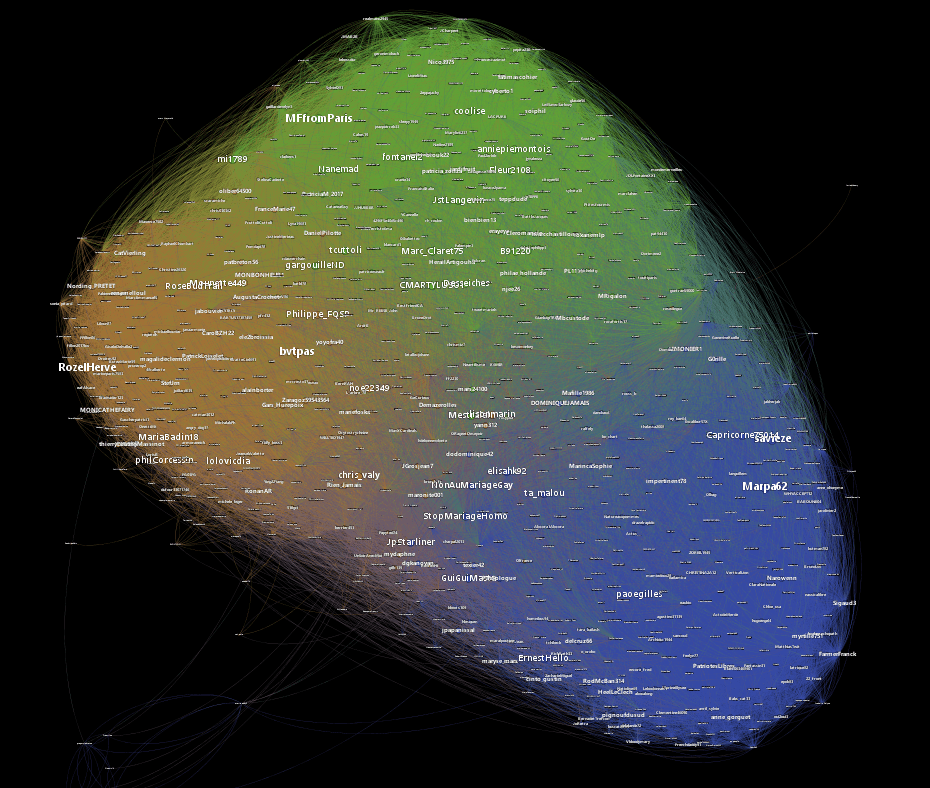
I then examined how they followed one another. This is shown in the following map. Each point you see represents a Twitter account, linked by lines that represent the fact that they follow one another. The bigger a point, the more the player relayed rumours. The minimum is 3, the maximum 7. Each colour represents a community, based on how closely they follow one another. (Clustering algorithm)
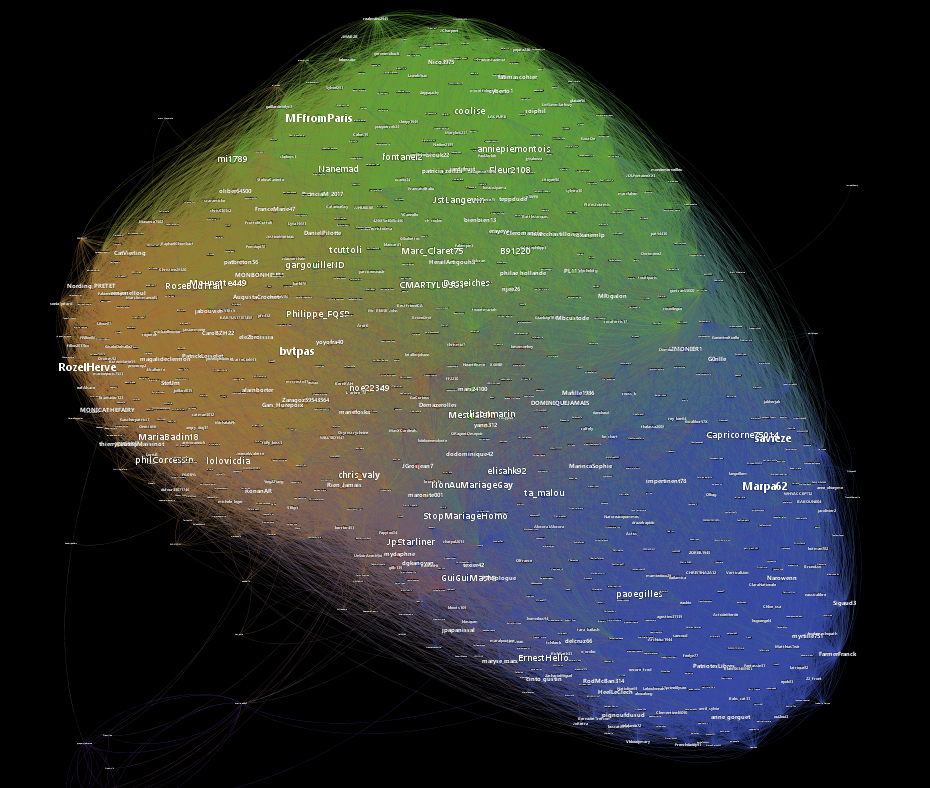
This other map shows, this time, the influential accounts in the ecosystem. (The fact that a player is followed by others in the graph)
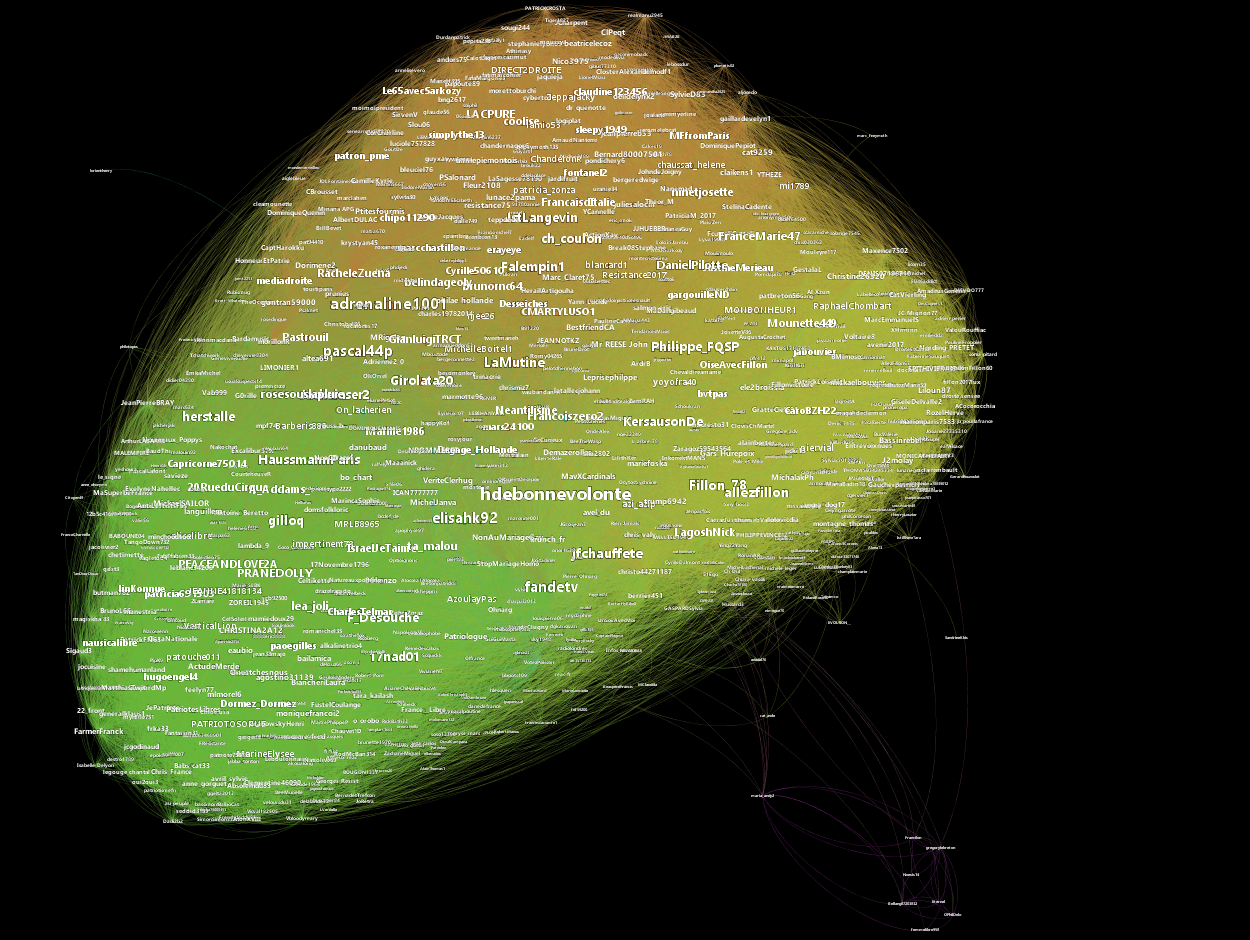
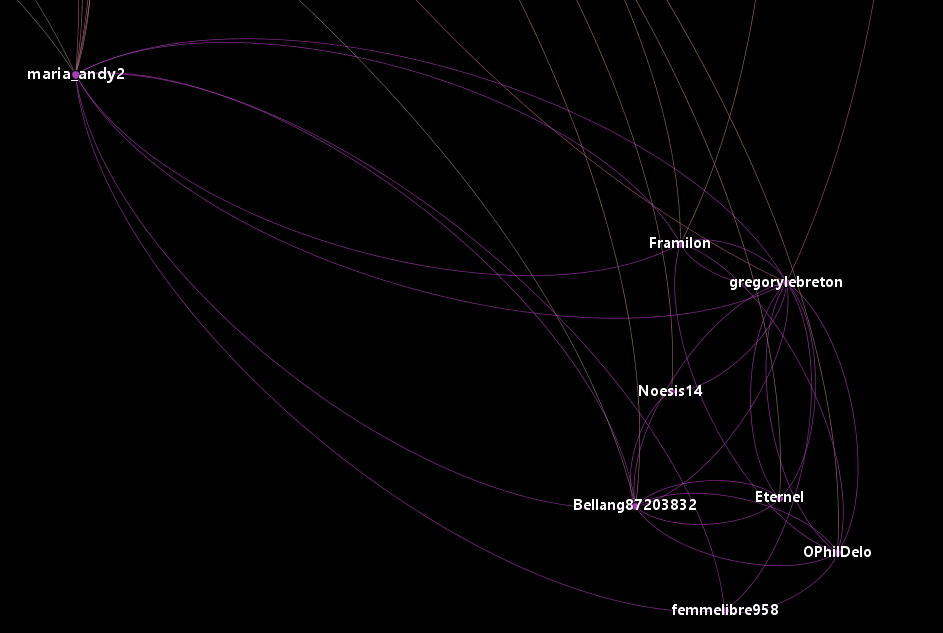
The small community at the bottom right is actually made up of accounts close to Emmanuel Macron that were quick to act to deny the rumours.
The breakdown of communities is as follows:
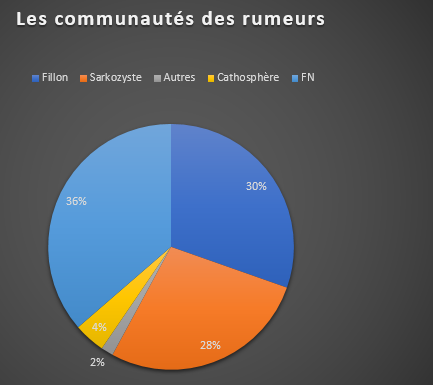
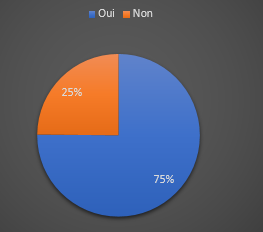
The majority of the communities are therefore Front National activists, followed by Fillonists and Sarkozyists. The latter two, taken together, outnumber the Front National. What is also particularly interesting is that when we cross-reference the accounts with my list of the 6,000 most active accounts retweeting or mentioning Sputnik and Russia Today, we obtain highly significant match rates, since 75% of the list are also those active around Russian propaganda.
The share of accounts that spread at least 3 rumours and are on the list of the most active around Russian propaganda.
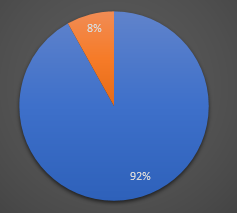
Taking those who spread at least 5 rumours, the share of accounts spreading rumours that are also among the most active around Russian propaganda comes to 92 percent.
III. Who are they? What do they share?
I then queried the Visibrain panel with all the tweets around the presidential election. (Mentions of all candidates or campaign slogans.) With barely 800 or so accounts, they generated no fewer than 1M tweets in two months, counting the RTs that stem from their tweets.
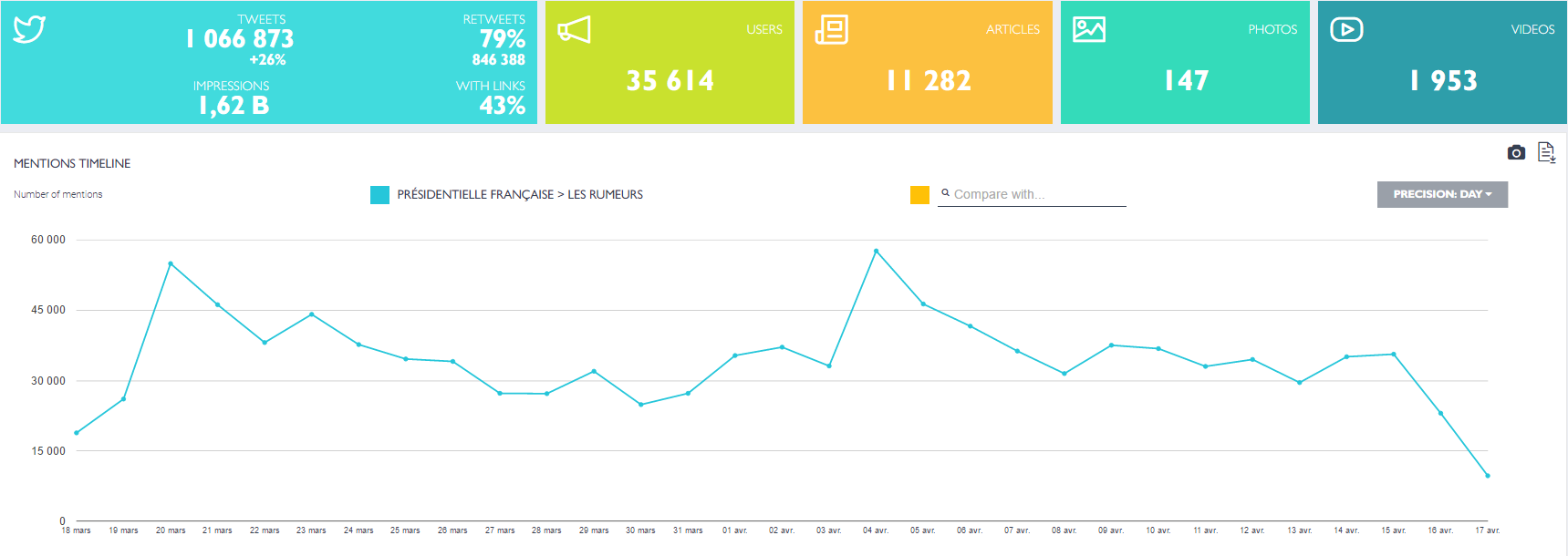
Although they support their candidate, the word they tweeted most is Macron. Ahead of mentions of Fillon or the #JeVoteFillon slogans.
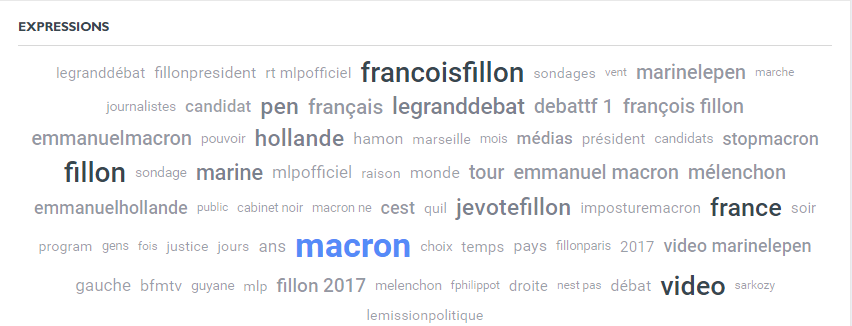
In the hashtags, this crusade against Emmanuel Macron is also found:
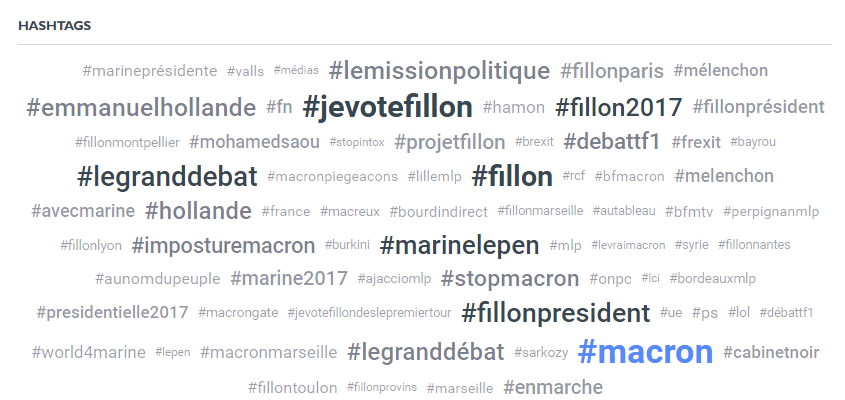
Thus, Macron is always the top hashtag ahead of #JeVoteFillon #FillonPresident, #Fillon2017 or MarineLepen. We also find one of the attacks picked up in the corpus (#EmmanuelHollande) and #impostureMacron or #macreux, even #MacronPiègeàcons.
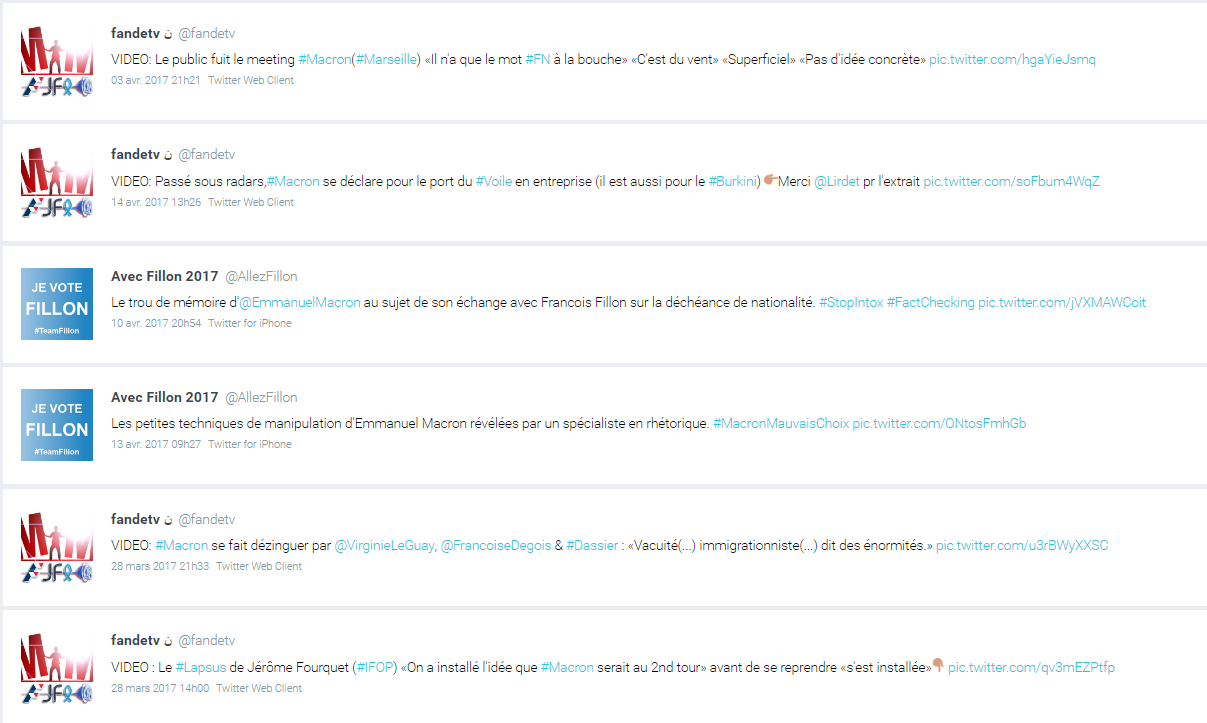
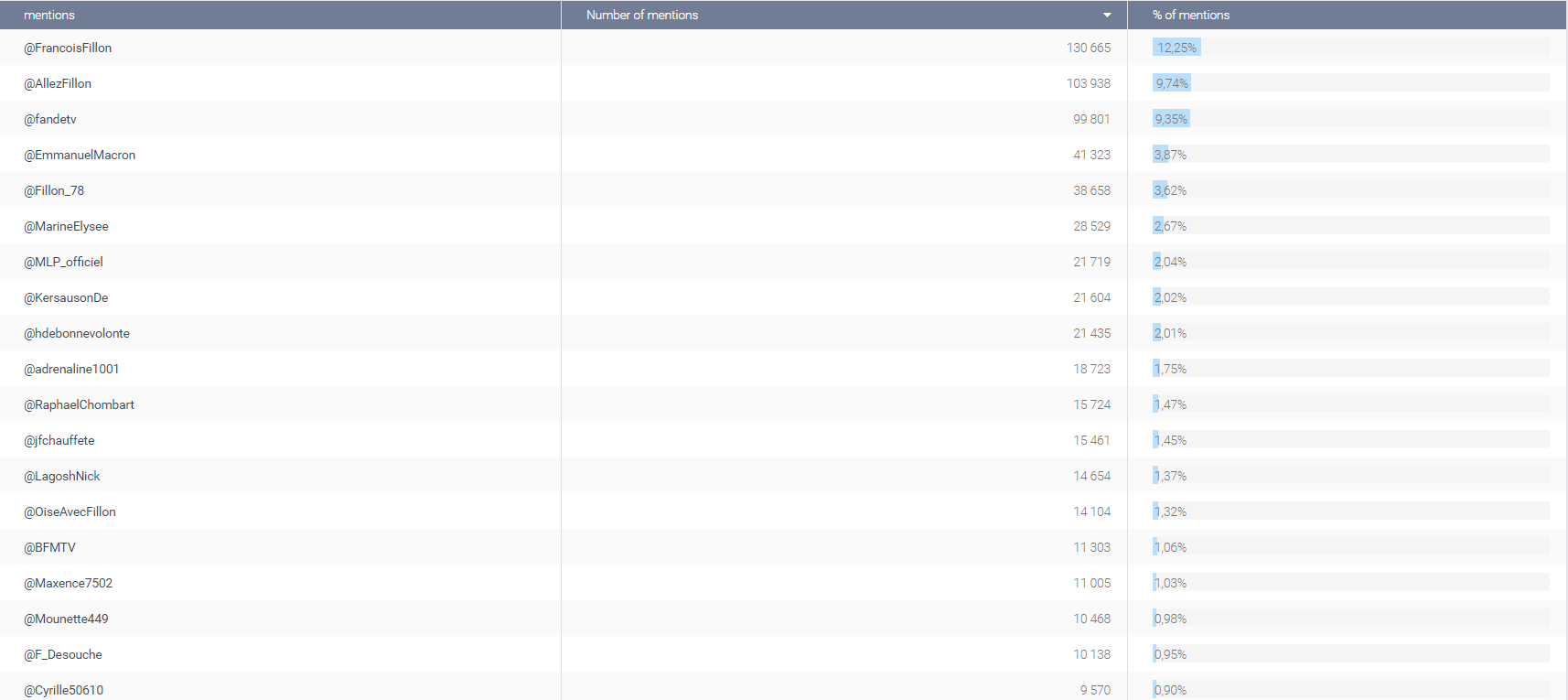
In the sample's top tweets, we find many FandeTV tweets attacking Macron as well as tweets from François Fillon's official campaign account. It is therefore no surprise that the top mentions are as follows:
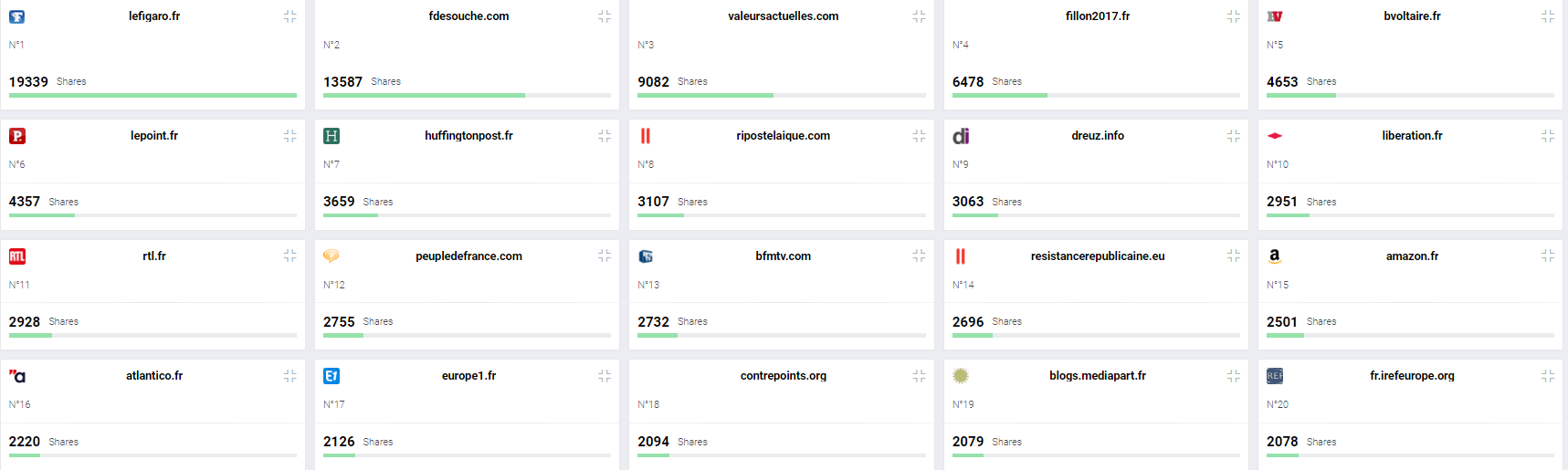
Among the most tweeted sites, we find Le Figaro, Frdesouche, Valeurs actuelles, Fillon2017's campaign site and Boulevard Voltaire. A mix of mainstream media and conspiracy media.
Conclusions
It is hard to say that the rumours come from the people identified. The hypothesis is that these accounts are heavily structured around anti-Macron propaganda and that, in carrying out this propaganda, every article, false or true, is used to feed the machine. These accounts are therefore on a crusade and are instrumentalised in the manufacture of fake news by other accounts, as we saw in the manufacture of false stories such as the Saudi financing or the Cahuzac/Macron connection. In this expedition, there are alliance strategies between Fillonist, Sarkozyst, Le Pen-supporting and cathosphere accounts. These are the same accounts that also spread the news as seen by RT and Sputnik. That is the little we can say on the basis of this analysis, which once again shows how hard it is to fight the spread of false information when its initiation and starting point are difficult to identify.