


Quite a few players in strategic social media monitoring have decided to release an image-based monitoring option. It was therefore time for this blog to look at the tool and assess the possibilities of this technique. A short tour based on 2 months of using the option provided by Brandwatch.
I. Introduction
Historically, almost all tools only allow reports by semantic objects. (Confined to words and languages.) Geolocation could also be mentioned, but the number of tools available (Twitter only) and the number of people who have activated the option make the approach not very productive.
In the meantime, the tools have also developed panels of authors. (Journalists, specialist lists, etc.)
In a world where image and video are becoming increasingly important (think of the growing influence of Instagram), image monitoring can prove valuable and represents a growth lever for monitoring platforms. Talkwalker launched its solution before the other players. Radarly and Brandwatch have now also released theirs. Some have their own native version, while others use Ditto or Logograb. I was able to test Brandwatch's solution on the Nutella logo.
II. Analysis
I tried to isolate the major benefits of this kind of solution as a monitoring professional, as a practitioner of reputation and crisis work, and as a former strategic planner in an advertising agency.
1. More occurrences
For me, the first thing that tickles my monitoring instincts is that far more mentions are covered. This closes one of the problems of semantic monitoring: capturing all products without necessarily being mentioned by name.
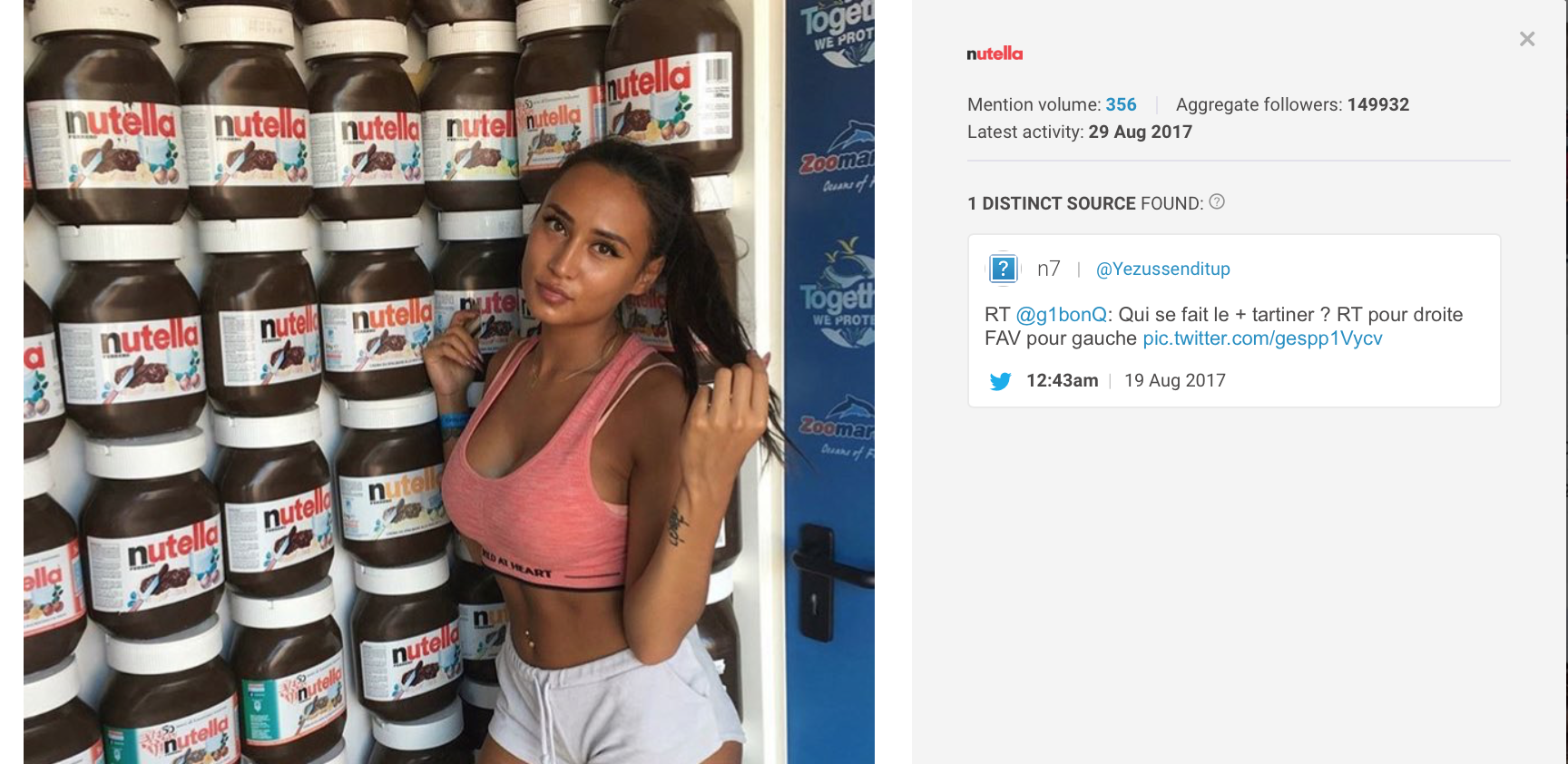
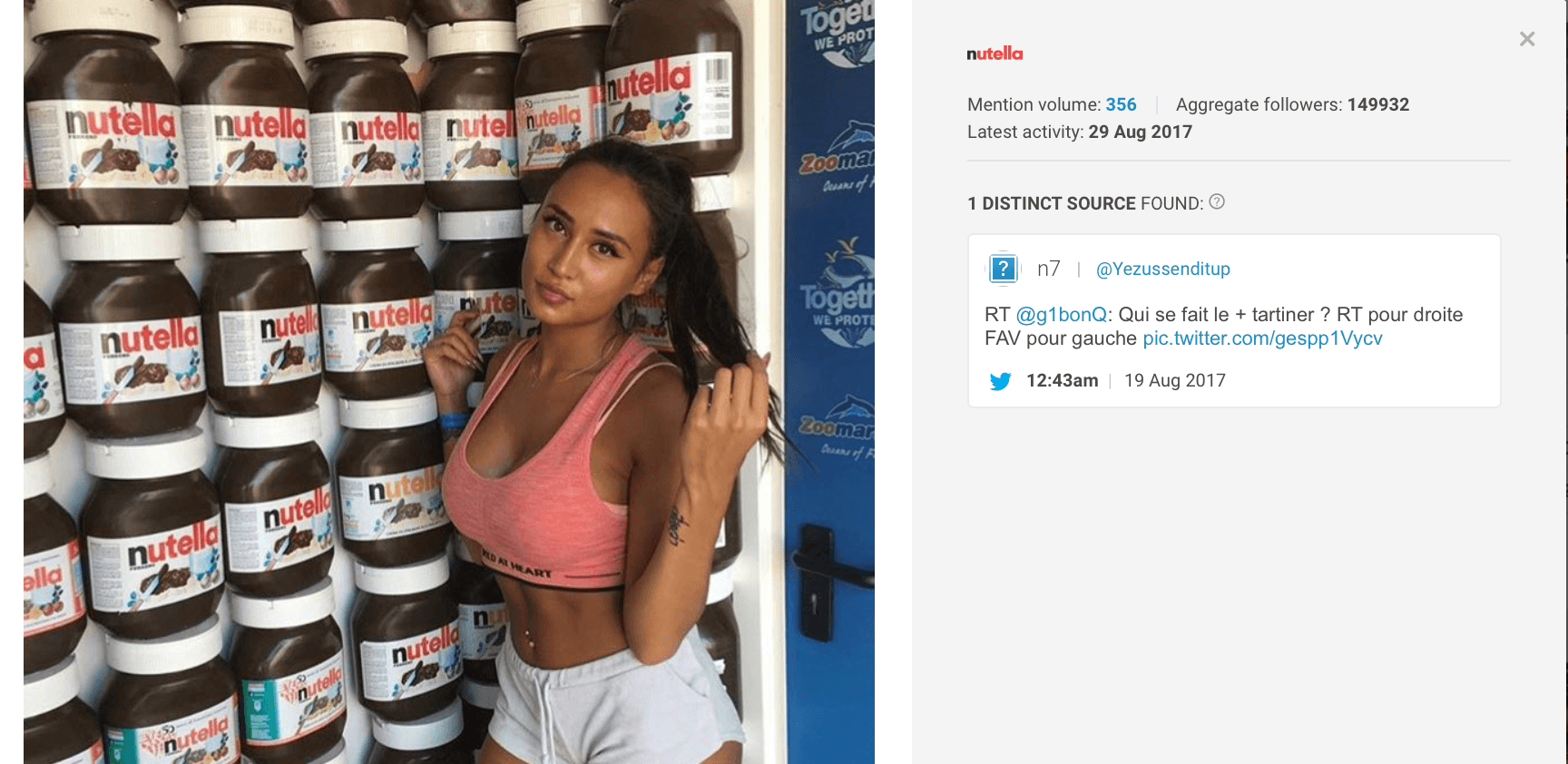
Here we see only one distinct source. In other cases, we see that the photo is used in other places.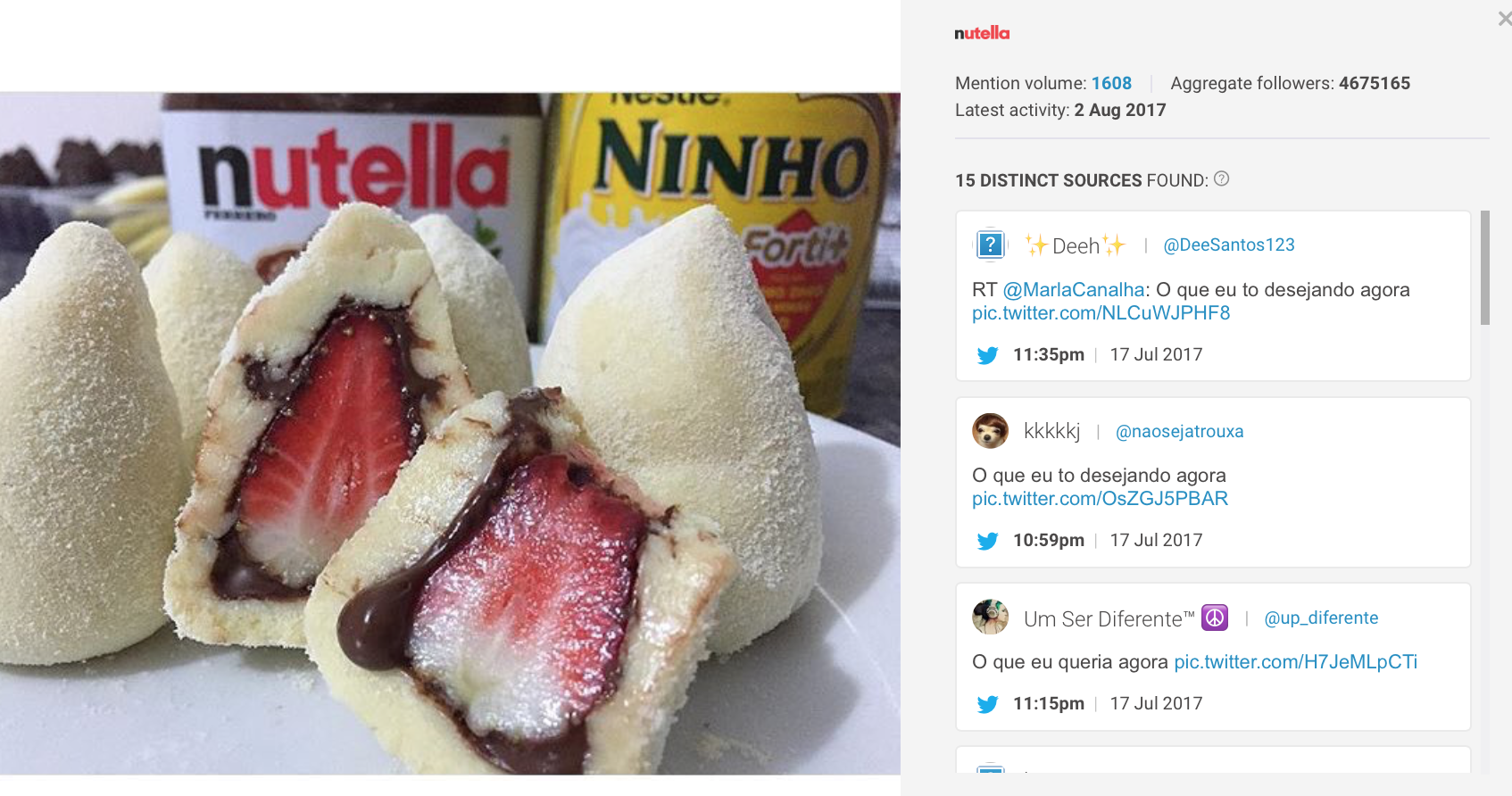
We also note that brand attachment is more often present without the brand being mentioned. (See the typology below.) One weak point of image monitoring could be how pricing evolves, since all services generally charge by number of mentions. For Brandwatch (I do not know about the others), the issue is sidestepped: once activation is done, the mentions captured do not cost a single cent, unlike semantic mentions.
2. The ability to build a typology of uses
It is now possible to build typologies of photographs featuring the product. In what situation is the product used? What are the uses of photographs with the product? (Particularly interesting for social media campaigns), etc. For example, for Nutella, it was possible to distinguish:
Brand attachment:
https://twitter.com/angeloclick/status/890975812266151936
I'm dazzled by so much beauty pic.twitter.com/K8Cs9nxddy
- math (@QuotesDeMathias) November 12, 2016
https://twitter.com/ByellMello1/status/888090417056686080
https://twitter.com/piersmanning60p/status/893456893967949826/
Food porn:
- Either as an ingredient:
https://twitter.com/ItsFoodPorn/statuses/884658771301150721
https://twitter.com/ExpressouVibe/status/869357703814098945
- Or as a constituent element of Ferrero products:
https://twitter.com/calmateforra/status/902967145872719876
https://twitter.com/dianeygallagher/status/890976207768039424
Sensitive situations:
If nutrition labels looked like this, do you think people would eat it? #Sugar #Nutrition pic.twitter.com/rZsRVLZqUD
- Michael I Goran, PhD (@DrMichaelGoran) August 24, 2017
Edits
https://twitter.com/The_Legend_2020/status/895006869139443713
https://twitter.com/The_Legend_2020/status/895003603953471489
3. An opening towards handling fake news
Widely used in the spread of fake news, images remain at times extremely hard to monitor. In time, the logo solution will soon evolve towards images in the full sense. It will then be possible to trace the trail of images and false information more effectively. Talkwalker also announces that a similar system for videos will soon be introduced. This could upend the field of monitoring, since YouTube and Dailymotion would become an additional source to process.
III. Conclusions
Image monitoring will be perfect for brand marketing, making it possible to see how the public appropriates a product, to build typologies of brand imagery, and other uses. It will also allow social media and event campaigns to be tracked, which could make it a good KPI measurement instrument.
It offers more suitable possibilities for monitoring sensitive situations, insofar as it can process far more occurrences than semantic monitoring.
Weaknesses remain, however. First of all, its cost. Even if the 313-euro plan for unlimited mentions remains affordable for large SMEs and big brands, the added value is still too low to justify an across-the-board investment by all brands. Lastly, another problem worth noting is its still too narrow monitoring scope. Logos are a first door opened. Other types of visuals (crisis-prone visuals, advertising posters, video, etc.) without a logo will broaden the importance of this new service. Moreover, for the moment, the sources covered are still too few. For Brandwatch, only Twitter was monitored for images, whereas its great strength would be on Instagram. (The solution should, however, be rolled out soon.)
As it stands, the solution seems to me mostly well suited to carrying out an e-reputation audit on a one-shot basis, not yet for permanent monitoring. However, once the monitoring scope and the possibilities of image monitoring have widened, image monitoring will become a necessity for most strategic monitoring set-ups.