


The 5 takeaways of our study:
- Adopt a precise or highly targeted approach for your decision-makers: we can see how much each network can fluctuate and change, and communities likewise
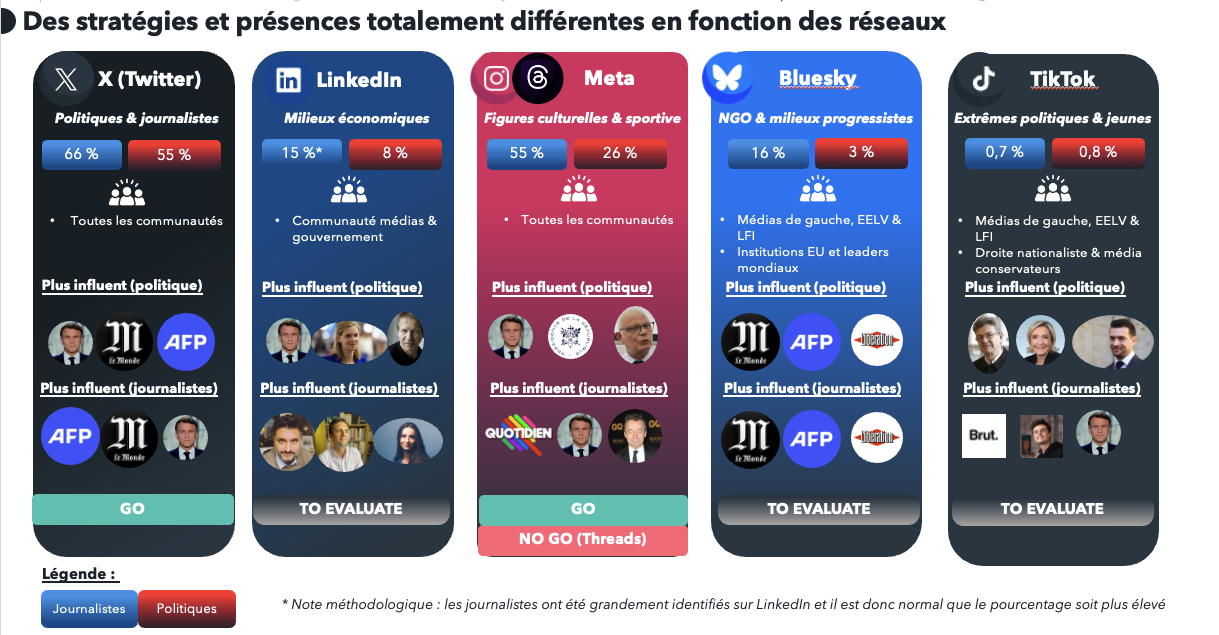
- The challenge will be to build a multi-network presence on the key networks : the extremes have pre-empted TikTok, the majority LinkedIn, the left Bluesky, while Instagram and X are unavoidable for politicians.
- Find the right relays: for each type of stakeholder, the relays of influence also vary from one community to another
- Companies and lobbies are absent : beyond the top 600 places for the leading lobbies & companies (Netflix France, no less) for journalists (234th with TF1 for politicians), the first CEO comes in at 1,337th! (and 1,572nd for politicians)
- Nothing is lost, nothing is created, everything is transformed : the study's results prove facts that are common and known to professionals. The challenge will be to see how these constants shift at the margin on a few key items.
In this study, we focus on politicians and journalists:
- What do they follow across all social media? What do they like on LinkedIn?
- What are their practices on social media?
- Who stands out in attracting these players?
- How can you attract them better?
The full presentation is available on YouTube.
The ecosystems
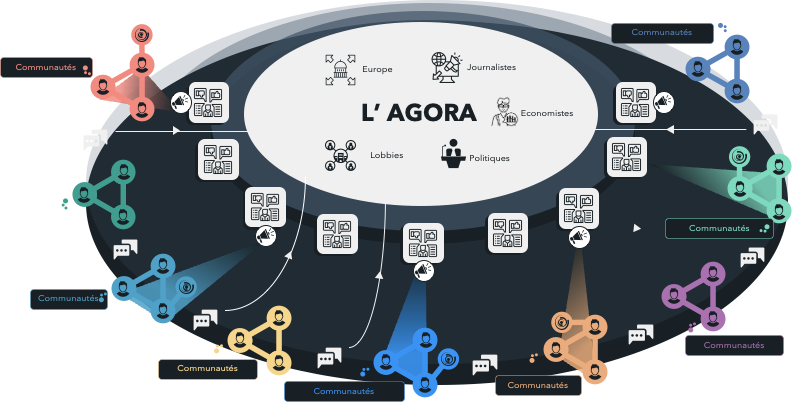
Here are the two ecosystems of influence, with tens of thousands of people to influence.
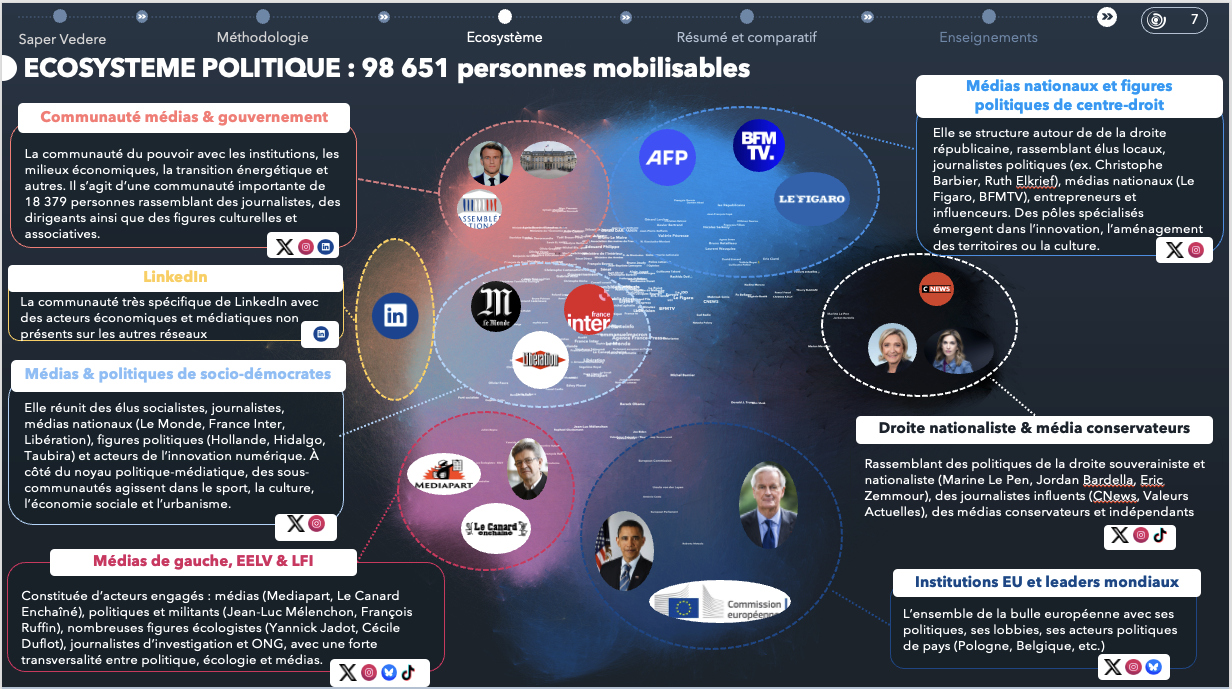
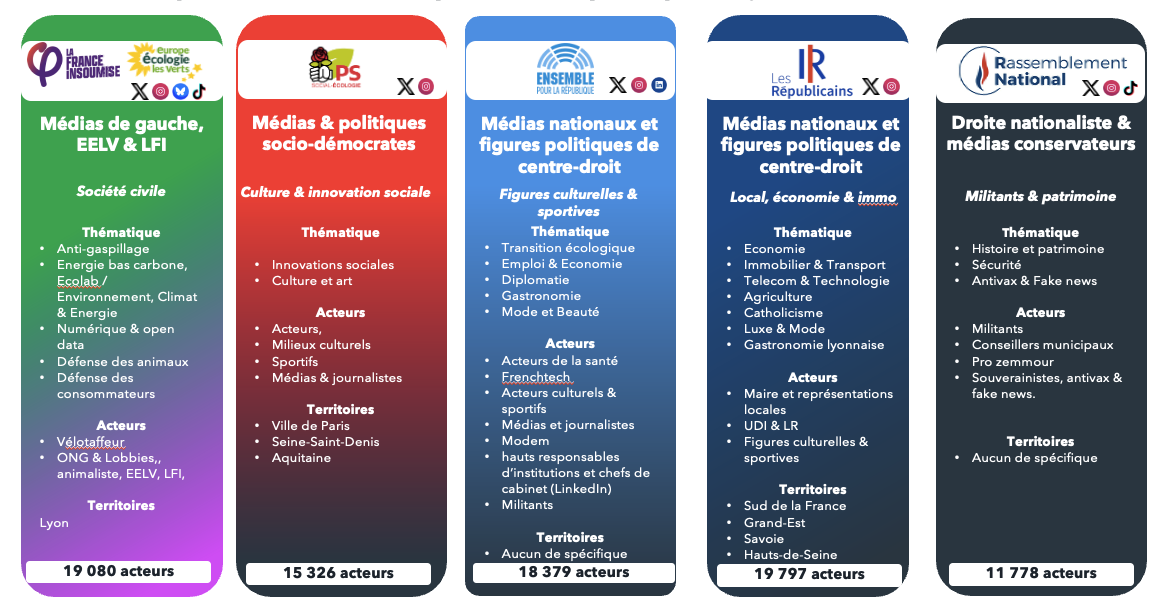
- Media & government community: The community of power, with institutions, business circles, the energy transition and more. It is a large community of 18,379 people bringing together journalists, business leaders and cultural and civil-society figures.
- Social-democrat media & politicians: It brings together socialist elected officials, journalists, national media (Le Monde, France Inter, Libération), political figures (Hollande, Hidalgo, Taubira) and digital innovation players. Alongside the political-media core, sub-communities operate in sport, culture, the social economy and urban planning.
- Left-wing media, EELV & LFI: Made up of committed players: media (Mediapart, Le Canard Enchaîné), politicians and activists (Jean-Luc Mélenchon, François Ruffin), many green figures (Yannick Jadot, Cécile Duflot), investigative journalists and NGOs, with strong crossover between politics, ecology and media.
- National media and centre-right political figures: It is structured around the republican right, bringing together local elected officials, political journalists (e.g. Christophe Barbier, Ruth Elkrief), national media (Le Figaro, BFMTV), entrepreneurs and influencers. Specialist hubs are emerging in innovation, regional planning and culture.
- Nationalist right & conservative media: Bringing together politicians of the sovereigntist and nationalist right (Marine Le Pen, Jordan Bardella, Eric Zemmour), influential journalists (CNews, Valeurs Actuelles), and conservative and independent media
- EU institutions and world leaders: The whole European bubble with its politicians, its lobbies and its political players from individual countries (Poland, Belgium, etc.)
- LinkedIn: The very specific LinkedIn community, with economic and media players not present on the other networks
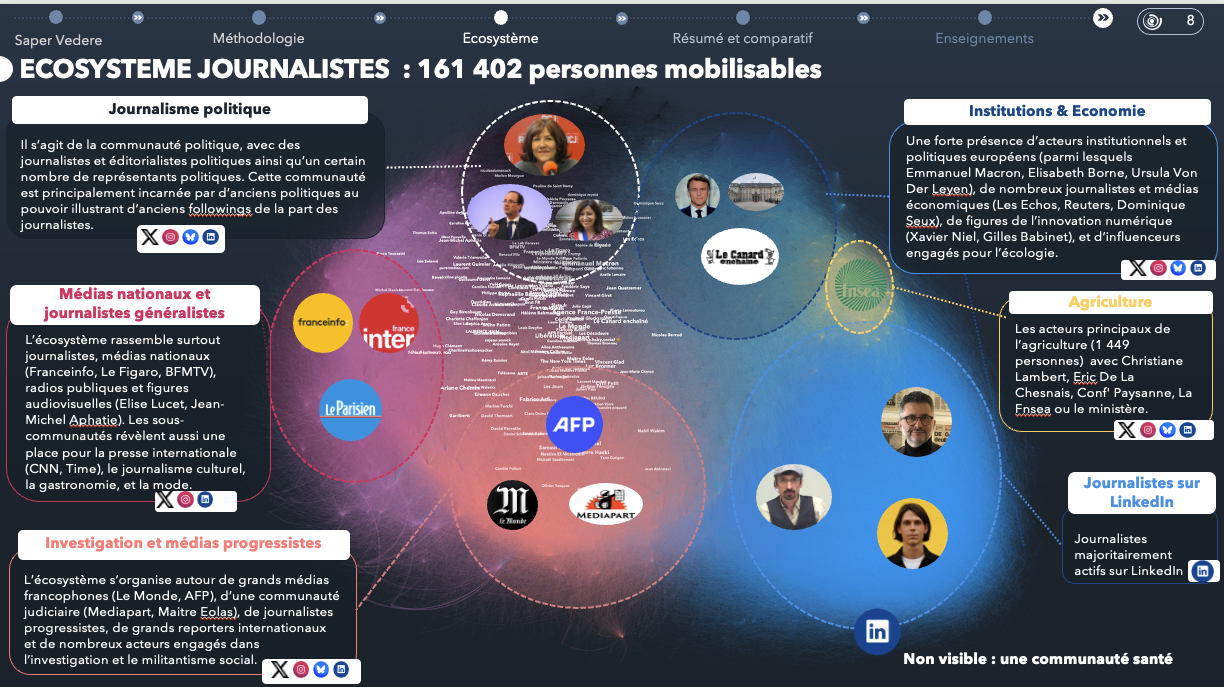
- Political journalism: This is the political community, with political journalists and commentators as well as a number of political representatives. This community is mainly embodied by former politicians in power, illustrating journalists' long-standing follows.
- Institutions & Economy: A strong presence of European institutional and political players (including Emmanuel Macron, Elisabeth Borne, Ursula Von Der Leyen), many economic journalists and media (Les Echos, Reuters, Dominique Seux), digital innovation figures (Xavier Niel, Gilles Babinet), and influencers committed to ecology.
- National media and general-interest journalists: The ecosystem mainly brings together journalists, national media (Franceinfo, Le Figaro, BFMTV), public radio stations and broadcast figures (Elise Lucet, Jean-Michel Aphatie). The sub-communities also reveal a place for the international press (CNN, Time), cultural journalism, gastronomy and fashion.
- Investigative and progressive media: The ecosystem is organised around major French-language media (Le Monde, AFP), a legal community (Mediapart, Maître Eolas), progressive journalists, leading international reporters and many players engaged in investigative work and social activism.
- Agriculture: The main players in agriculture (1,449 people) with Christiane Lambert, Eric De La Chesnais, Conf’ Paysanne, La Fnsea or the ministry.
- Journalists on LinkedIn: Journalists mostly active on LinkedIn
Comparing the two ecosystems
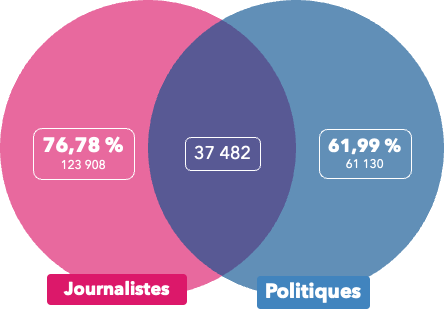
There are ultimately very few players in common (23% of those who matter to journalists and 38% of those who matter to politicians). The players absent from the politicians' list are essentially journalists present on LinkedIn. Those absent from the journalists' list are fairly specific lobbies or very regional accounts (Les Patriotes Meuse, Jeunes_insoumis_Perpignan, etc.)
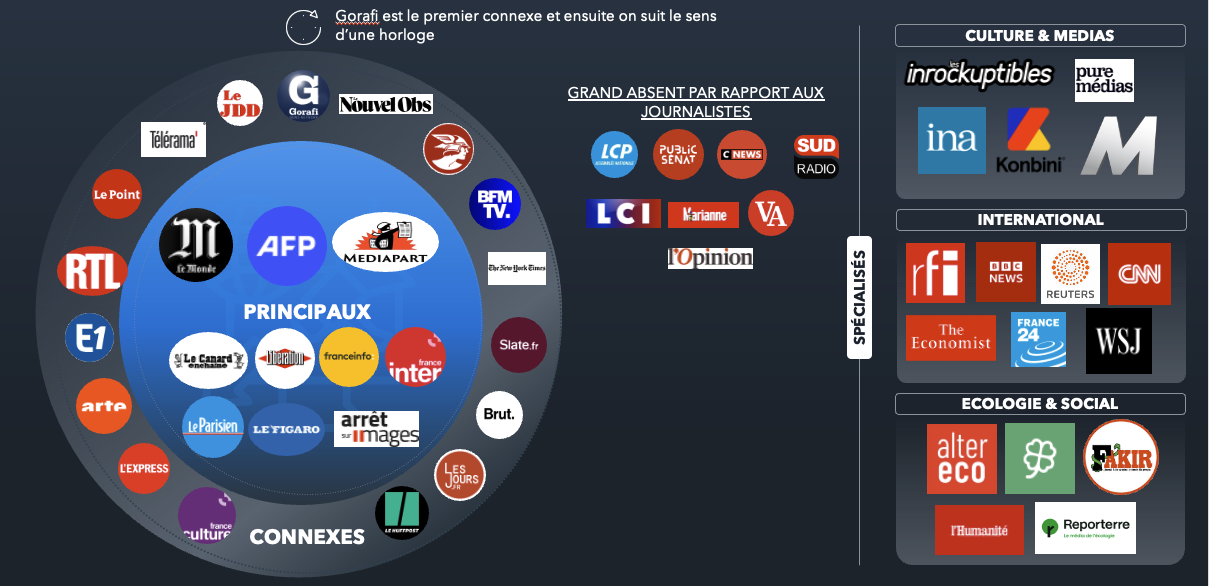
In terms of media, we see more investigative outlets and left-leaning media among journalists:
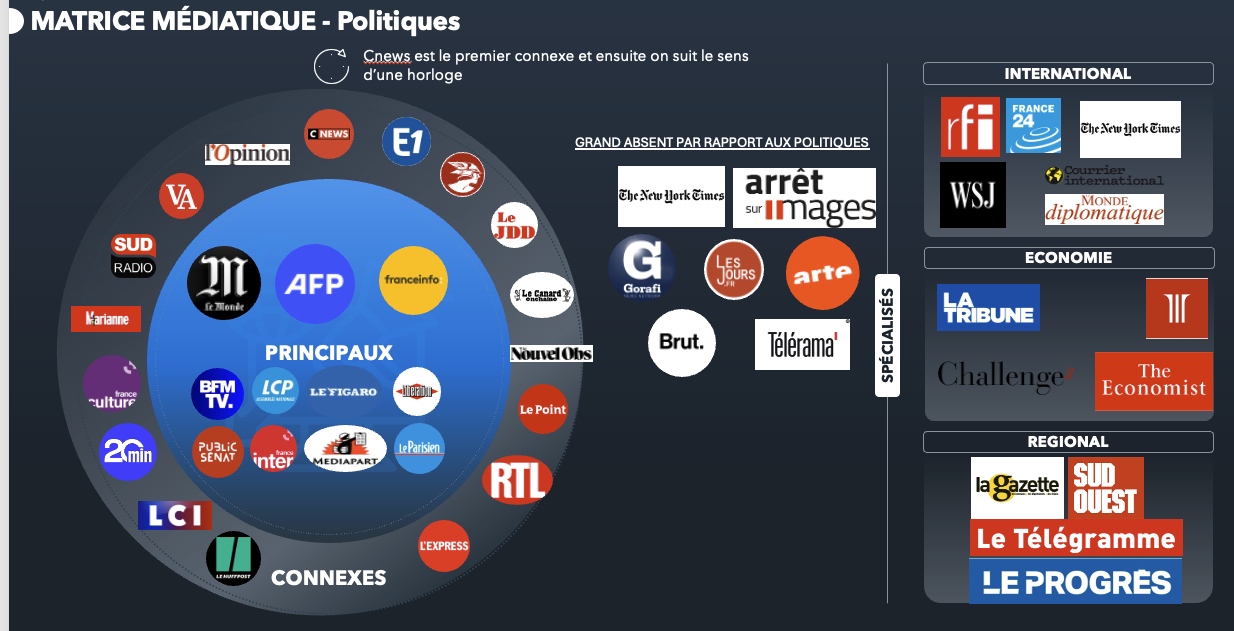
Than among politicians:
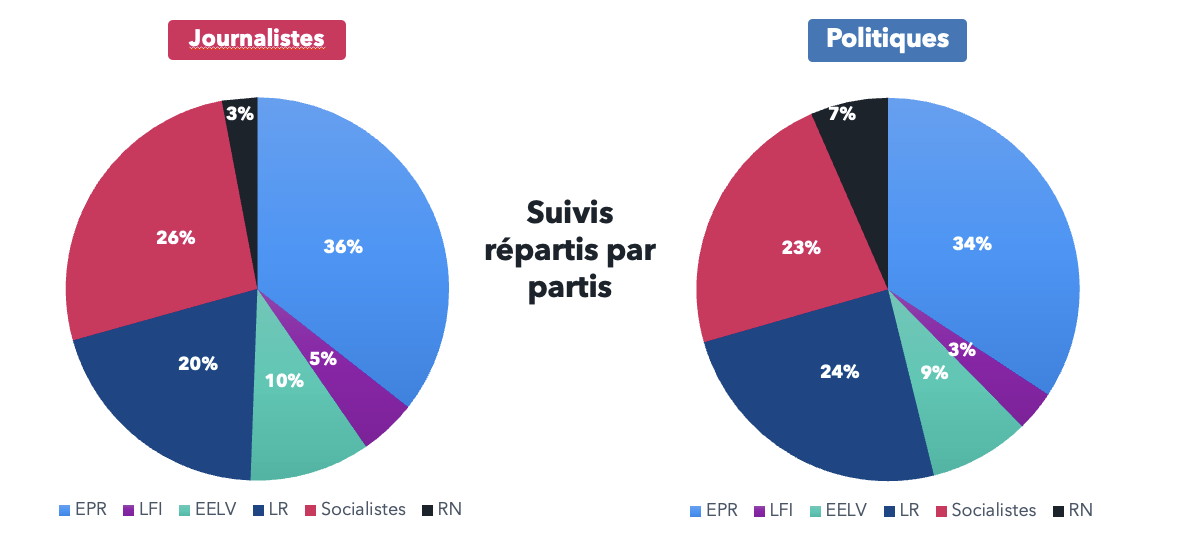
They are fairly similar politically:
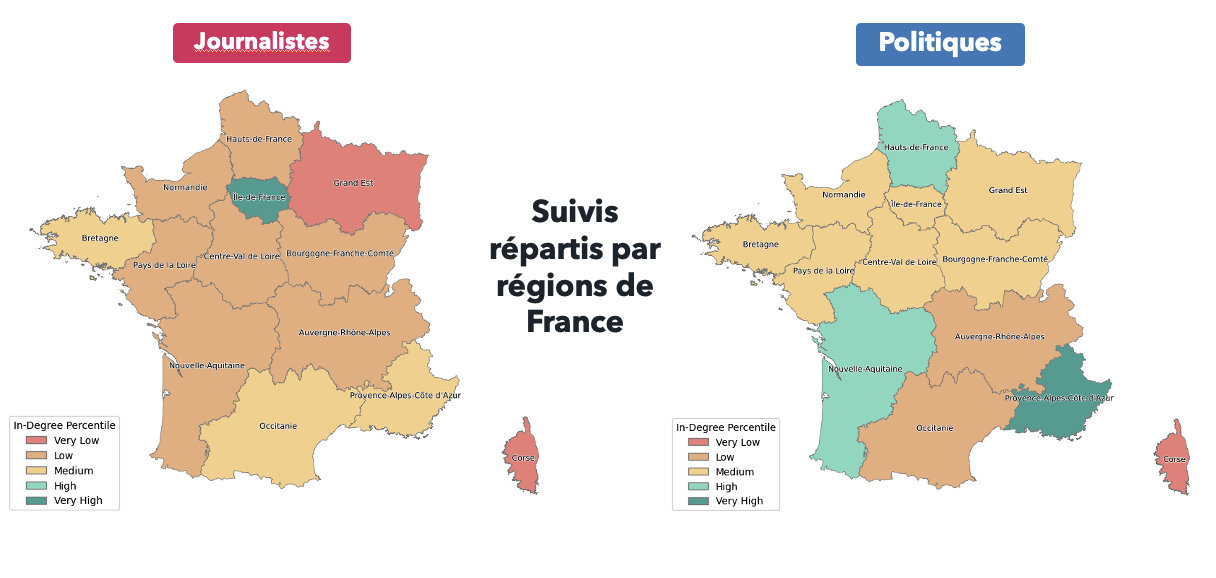
But in terms of the regions they follow, journalists show a real Paris bias whereas politicians' focus is regional (right for Paca, left for Aquitaine, RN and others in the North):
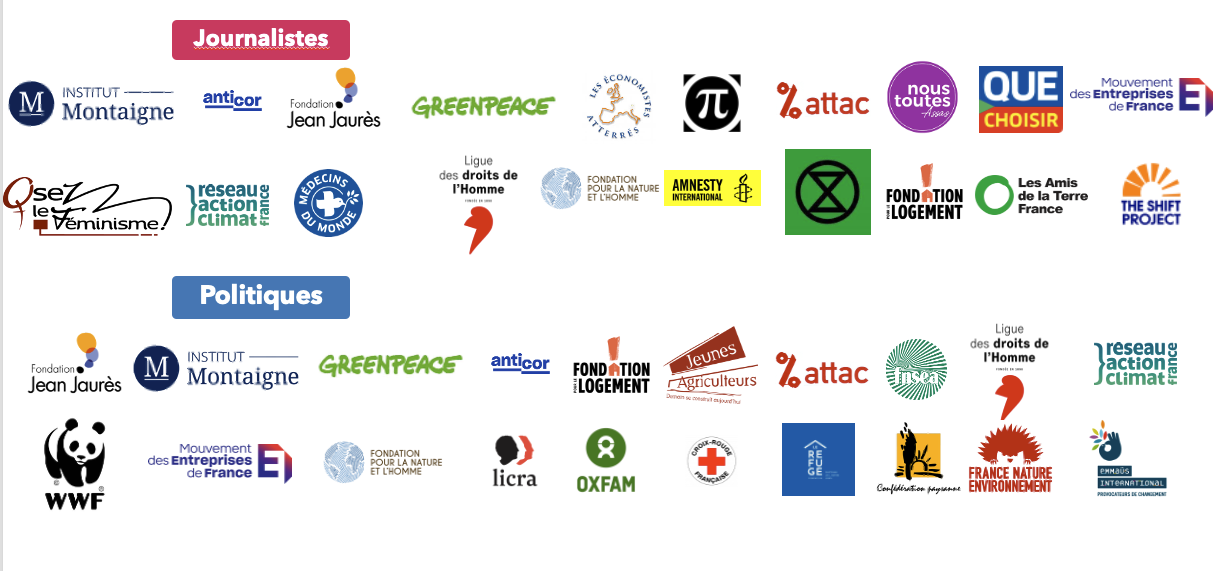
In terms of the lobbies followed, the same trend as for media, with lobbies slightly further left among journalists:
Among politicians, this is how they break down:
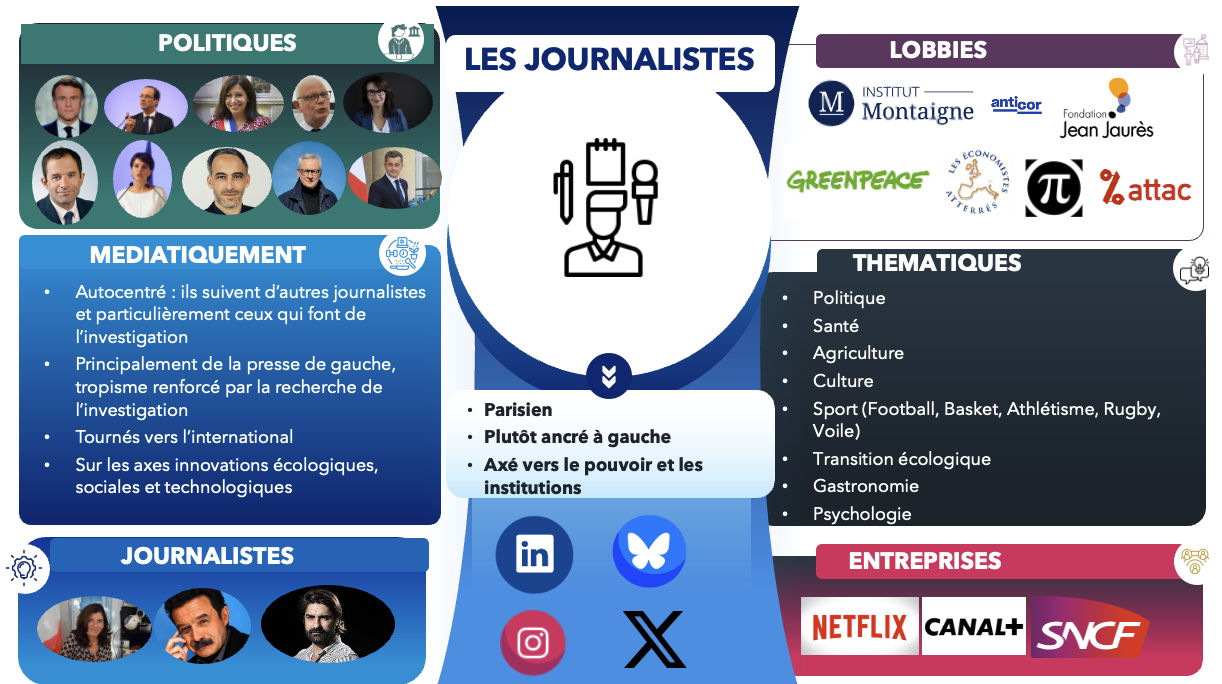
Whereas the journalist stereotype is this:
In the end, we have fairly disparate social networks:
Lessons learned
Journalists
It leans strongly left, but in a neutral way
Even if the ecosystem is relatively neutral, showing no ideological division among journalists within the large communities, it has to be said that the ecosystem leans left, both in the people followed and in the media followed. One fact illustrates this on its own: Attac is more influential than the MEDEF! (Among politicians too.) Likewise the Confédération paysanne is followed more than the FNSEA.
Journalists are present everywhere, but not on TikTok and Threads
Journalists are present on every network except TikTok and Threads (where their presence is tiny, even non-existent). They do not change their follows much, as illustrated very strongly by the presence of former figures in power (François Hollande, Najat Vallaud Belkacem, Benoît Hamon, etc.)
The agricultural sector is a good example, emerging thanks to its presence
on the 4 key networks. Lastly, many journalists and key players have left X for Bluesky, judging by biographies and labels.
LinkedIn largely neglected and journalists isolated from one another
Journalists obviously follow mainly one another. On LinkedIn, the only posts liked are mostly those of other journalists. This is explained in particular by their school networks.
Recommendations for journalists:
Traditional PR remains the best way
The best way to reach them therefore remains traditional PR combined with outreach measures: tags, followings, long-term relationships.
Multiply your presence
Each social network (X, Bluesky, LinkedIn and Instagram) brings specific audiences that cannot be found on the other networks.
Use relays
Journalists follow the VIPs in our panel very closely, namely civil society players who are influential on television sets.
Logical, since these are their potential interviewees, guests and sources of information!
Politicians
Different network strategies
While EPR is present on LinkedIn and very influential on Instagram, making the most of its years in power to have institutions and cultural players in its communities, the extremes have fully invaded TikTok. The finding is quite striking for the RN. The left is, unsurprisingly, more present on Bluesky. More traditional parties such as the PS and LR have stayed on Instagram and X as their only network, which now limits their influence.
Strong local connection towards the South and the Hauts-de-France
Whether through the press or through activists, politicians have many local connections, mainly via local and regional branches.
Outside the RN, however, few activists and political supporters are followed.
Cultural, sporting and artistic figures in every community
With the exception of the RN's sovereigntist community, every community (socialists, LFI/EELV, EPR and LR) follows cultural, artistic and sporting figures specific to that community.
Recommendations
The local route
Politicians are closely connected with local branches, towns and cities, and local media. It remains a more direct way of having an impact through social media. That said, coverage fluctuates from one network to another.
Win likes from chiefs of staff on LinkedIn
With LinkedIn's “look-alike audience” algorithm, plus the large number of chiefs of staff on the platform, this makes for a very good lever of influence.
Use cultural and sporting relays
Each political community has its own artists and sportspeople. They can be powerful levers for reaching politicians.
Methodology
Journalists
We isolated the journalists thanks to our Follaw.sv panel (20,000 opinion leaders), which we completed by using LinkedIn to isolate the newsrooms of all the main media. In total, 2,969 journalists are analysed in the study.
Politicians
From our panel of 20,000 opinion leaders, we isolated the politicians, representing 5,741 people:
- National and European MPs
- Senators
- European ministers and commissioners
- Municipal, departmental and regional councillors
- The strong, prominent figures of the various parties.
Reconstructing the ecosystem of decision-makers
We then reconstructed the decision-makers' ecosystems of influence on:
The specificity of LinkedIn: the analysis does not allow us to reconstruct the people followed, we can only analyse interactions over a period of at least one year or 365 interactions.

We then merged similar identities across networks in order to obtain 107 different metadata points and indicators.