


In his New Year address to the press, Emmanuel Macron announced an anti-fake news law in an election context. As it stands, it is an interesting initiative, but it is only a grain of sand in the desert and it will run into many obstacles.
The definition of fake news
The fact is that the term fake news is a non-word. It is a buzzword with no theoretical substance. Used by everyone, each person has their own definition. While that may suffice in a media context to label a type of subject, a definition is indispensable once it becomes law. What is fake news? Are we talking about unconfirmed news? (Pénélope Fillon in Le Canard Enchaîné?) Are we talking about information that later proves erroneous? (The typical case of the fake study, or the hoax) Are we talking about a reading of an event? The simple reaction of many French and Belgian journalists calling for a journalistic ethics council illustrates that Emmanuel Macron, recipients, journalists and other players are not talking about the same thing. Problem: if the definition of fake news is too broad, it risks encroaching on fundamental freedoms (expression, press, etc.)
The total complexity of the phenomenon during elections
However, let us take only the contextual framework applied by Emmanuel Macron, namely elections. If a legislative framework is needed in elections, it is when the electoral process is being manipulated. In my view, there are three possible forms of fake news in this very specific framework:
1. A foreign influence operation based on erroneous information.
A piece of false information is created and manipulated in order to ensure its spread within certain circles.
- When Russia, through a propaganda agency, uses sponsored advertising, for example to target people who like Donald Trump, to push a fake news story about Hillary
- When an organisation or group copied the website of the Belgian daily Le Soir. Same site, same logo, same interface. (The site address was lesoir.info, not lesoir.be) With one exception: an article stating that Emmanuel Macron was funded by Saudi Arabia. And four fake accounts with generic names sent the link to the press, along with accounts that dislike Emmanuel Macron, so that they would relay it.
- When the blog platform of Mediapart or L'Express's Express Yourselves, which provide a personal publishing space, were used to relay a rumour that Emmanuel Macron had a hidden bank account, relayed overnight by more than 80 accounts created for the occasion.
- When Philippot or one of his activists doctors the image of a text message to suggest a call for the lynching of Marine Le Pen
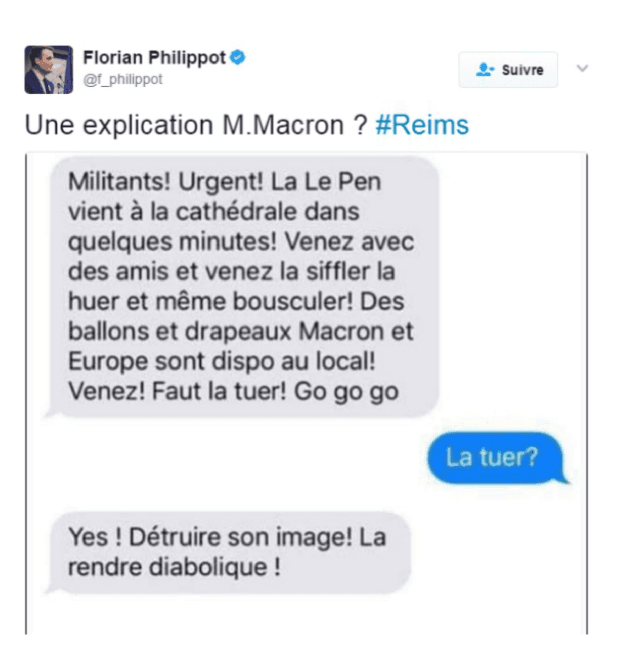 What can be done about this? The rumour is placed in a temporary space that is known to be about to disappear. No host is used, or only in a roundabout way. Even if we had the information on the Russian advertisers for Facebook, they would only have to create another company to do exactly the same job. No legislation, no procedure can combat this. A systemic response is needed. Likewise, insofar as this information circulates through real people who genuinely believe they are sharing real information. Can these real people be punished in a state governed by the rule of law?
2. An influence operation based on truthful information
Information that is truthful at the outset is manipulated to angle its treatment further.
- When individuals reuse an old sequence broadcast at the time on the France 3 news, in which Emmanuel Macron is seen washing his hands after meeting fishmongers. The sequence preceding this moment showed that he had touched a fish handed to him by one of the fishermen. With that now hidden, the impression left is chilling, as it really looks as though he is washing his hands after meeting “the lowest of the rabble”. That is how, during his visit to the Whirlpool workers, some workers shouted this at him. Once questioned by journalists, they stoutly defended their version.
- Ali Juppé: when Alain Juppé is portrayed as a Muslim man and accused of being in the pay of Islam, without much false information, but by producing a mix of several pieces of information, some of which contain approximations.
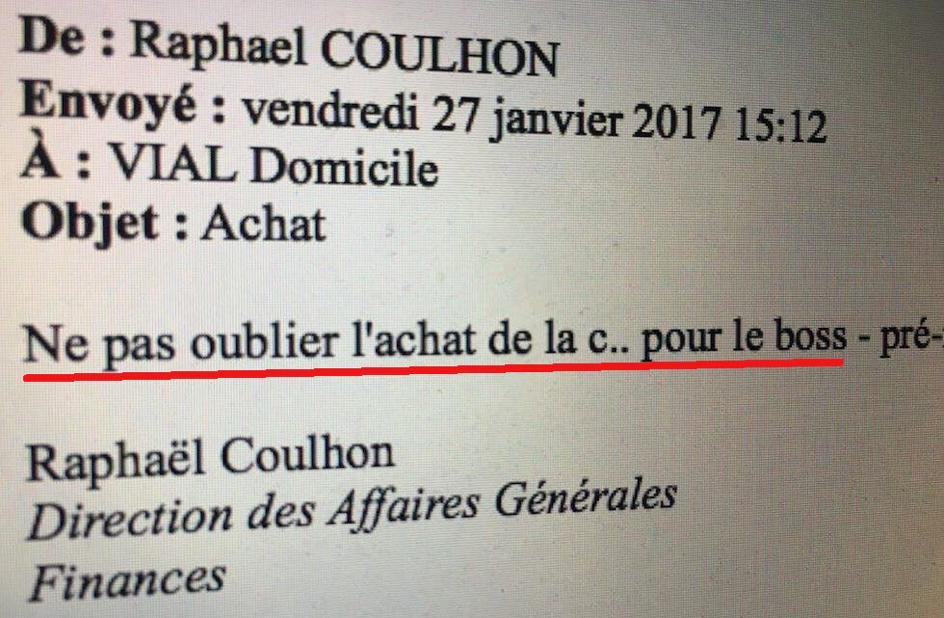
- When, during the Macronleaks, genuine emails were leaked and fake emails slipped in to influence the election.
What can be done about this? There is nothing more genuine than real information or a real video. When Alain Juppé is painted as “Ali Juppé” through a mix of information, some of it erroneous, is that satire? Fake news? Can those who relay it be punished? Under what law? Moreover, once again, Facebook and Twitter ads are not used and no host relays it plainly and simply.
3. The framing of information
A far broader process, which consists not in inventing or falsifying information but in applying another reading frame to it. It is, in a way, “framing”, the lens through which the facts are viewed.
- When Sputnik talks about the Macronleaks, saying they came from Wikileaks and this creates real unrest among the population. No false information, only a way of seeing things.
- When Russia Today or Sputnik make their front page and 90% of their coverage about riots or crime stories of rape committed by foreigners. These facts are real.
What can be done about this? Can a media outlet be punished for angling its information and the way it treats events? That is the basis of a media outlet's editorial line. A media outlet cannot be punished for its choice or framing of information. Likewise, will an ethics council serve any purpose against these foreign media? FRDeSouche, Dreuz and others are not even media outlets. What can be done? Nothing is possible. This is freedom of expression within the limits of the legislative frameworks that already exist.
Conclusion
The debate is too complex. First, because there is no agreement on the definition of fake news, the term being an empty shell. Second, because the reality of fake news cannot be tackled by a law alone. The parallel with piracy is striking. It is illegal, but everyone does it. It took low-cost general streaming services to fight it effectively. The response was political, economic and legislative. The fact is that the response to a system can only be systemic: everyone will be needed around the table, with a common response. This is beginning to change, notably at European level. Digital players such as Google, through its Google News Labs, or Twitter, which has really decided to step things up, are also engaged and good pupils on the subject. There will remain the holdouts who prefer to settle problems on their own. Among them, Facebook, which prefers to put plasters on open wounds to say it is doing something, while at conferences on the subject they are always conspicuously absent, believing that only Facebook can fix Facebook. Let us hope the French government will also have a comprehensive response involving all the players, and not just a law that will inevitably be labelled as authoritarian.