


The elections are drawing to a close. It is a good moment to look back at politicians' presence strategies in a world where the number of social media platforms has exploded over time. This explosion has created many spaces, each with its own dynamics and stakes.
Summary
- TikTok is a network that is hard to grasp with conventional follow-based methods, because followings have little influence on the timeline, with an ecosystem dominated by LFI and the RN, along with YouTubers, media outlets and celebrities. Although the platform's figures (on views and followers) are misleading and skewed, it remains powerful for reaching a wide audience, requiring simplified formats and messages to be effective.
- X remains the political and societal network par excellence thanks to its unique ecosystem linking journalists, politicians and pressure groups, which allows important statements to spread quickly. It also hosts communities centred on health, agriculture, the economy and start-ups.
- On Instagram, the ecosystem is mainly built around activism with a Renaissance presence (inherited from 2017 and the young Macronists). Given its outdated search engine, its convinced and activist audiences, its limited capacity for expression and its “past its trend” feel, it is today of little interest for political communication.
- On LinkedIn, we identify communities comprising institutions, business media, politically influential sectors such as health and energy, and societal players such as impact movements and NGOs. The network is very interesting for developing an expert message for professionals and interest groups.
- On Bluesky, you are talking to dead accounts and a few left-wing people who are still convinced the network has a future.
TikTok
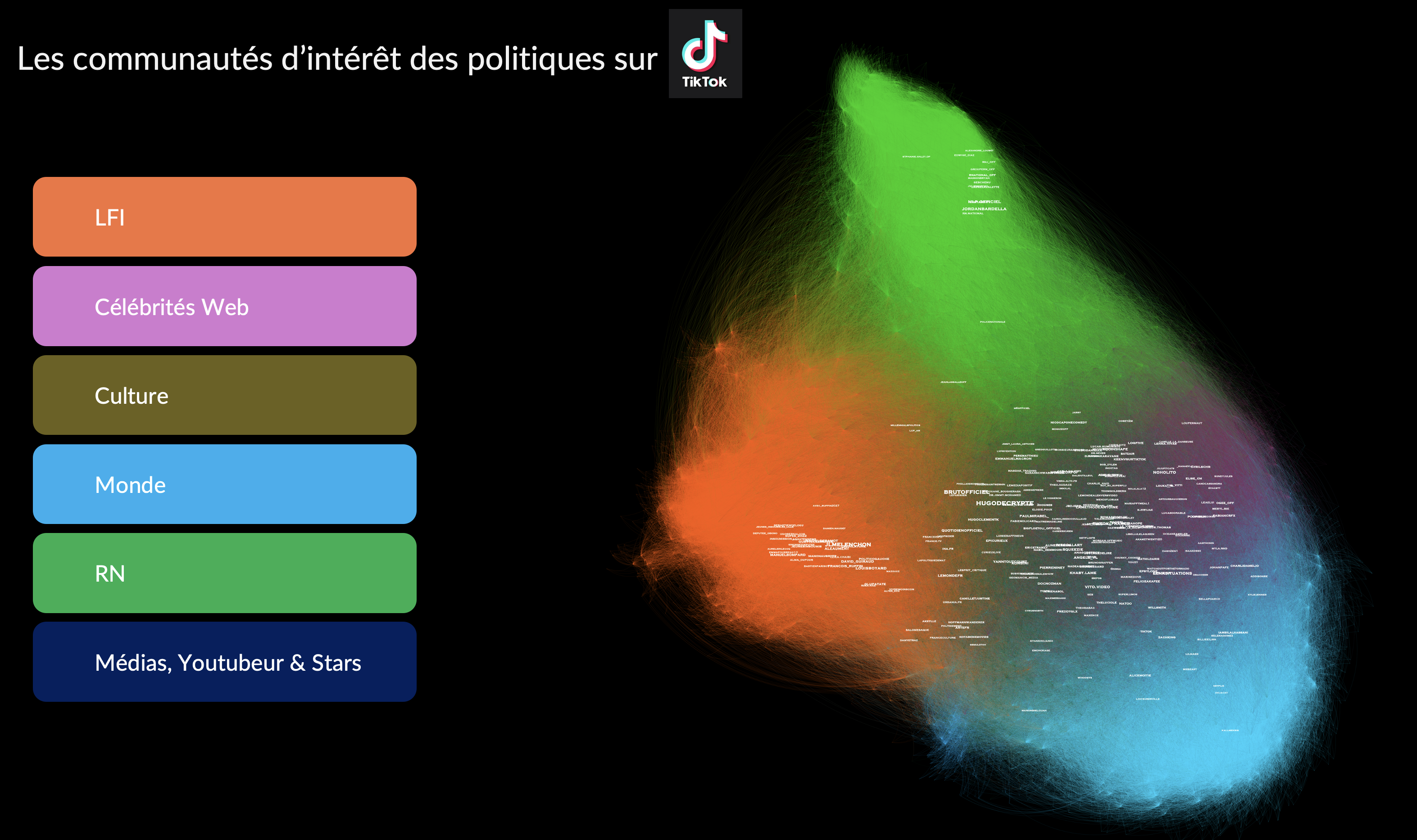
A network that is hard to grasp with the follow-based methodology used for other networks, since it is a network where the accounts people follow have very little influence on the timeline.
We therefore have an ecosystem organised fairly closely around activism, with a strong presence of LFI and the RN. Beyond that, there are YouTubers, media outlets and celebrities.
It also remains a network that is hard to grasp in general, for the simple reason that the figures the platform provides are completely misleading. In a sample of the 7,200 most politically influential accounts on the network, the person most followed by the others in the sample has 1,000 followers. (And with a total of 57k people, which also shows that few people speak on TikTok and most are spectators.) The follower count displayed is therefore totally impossible. The number of views per video is also heavily skewed. However, even skewed, the results can be impressive, particularly in the ability to reach the general public, as few other social networks (Facebook, Instagram, etc.) have done before.
The challenge is to find the right formats and the right hooks, and to simplify your message to the extreme.
Objective:
- Simplifying your statements or messages
Target:
- General public
X
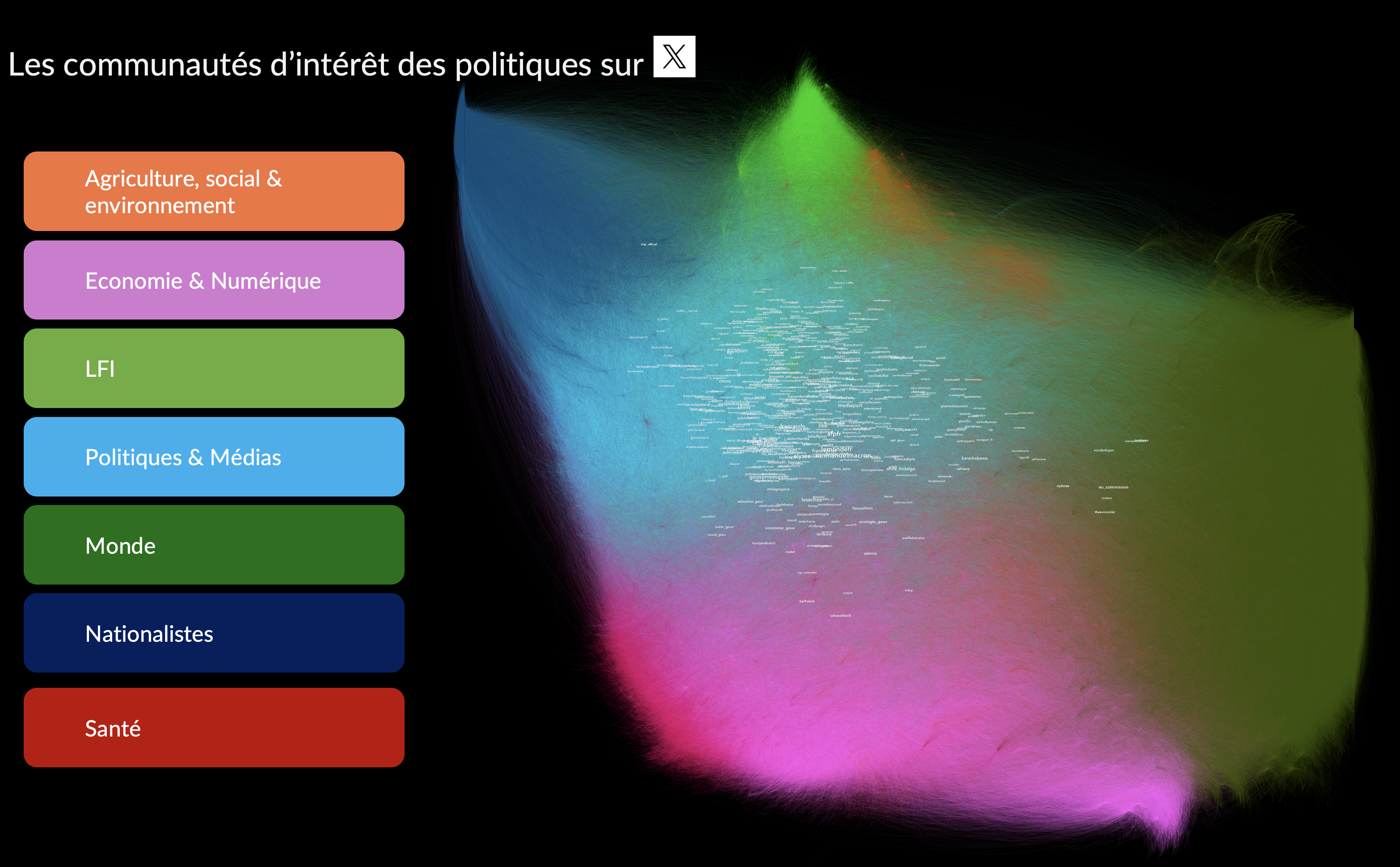
We begin with the historic network, which is also the densest. Despite the storms, X remains the political and societal network par excellence. Its unique ecosystem linking journalists, politicians and pressure groups, and its open system, make it the place for every political campaign. It remains a network where, in the event of major news, it is possible to place statements that are then picked up directly on social media. The reason the other networks are far behind is a restricted or ineffective search engine.
In terms of communities, there is a health angle and an agriculture angle outside a political ecosystem. There is also a large business and start-up community.
Objective:
- Speaking to interest representatives
- Positioning yourself in the media
- Getting a topic to rise
Target:
- Journalists
- Lobbies
- Campaigners
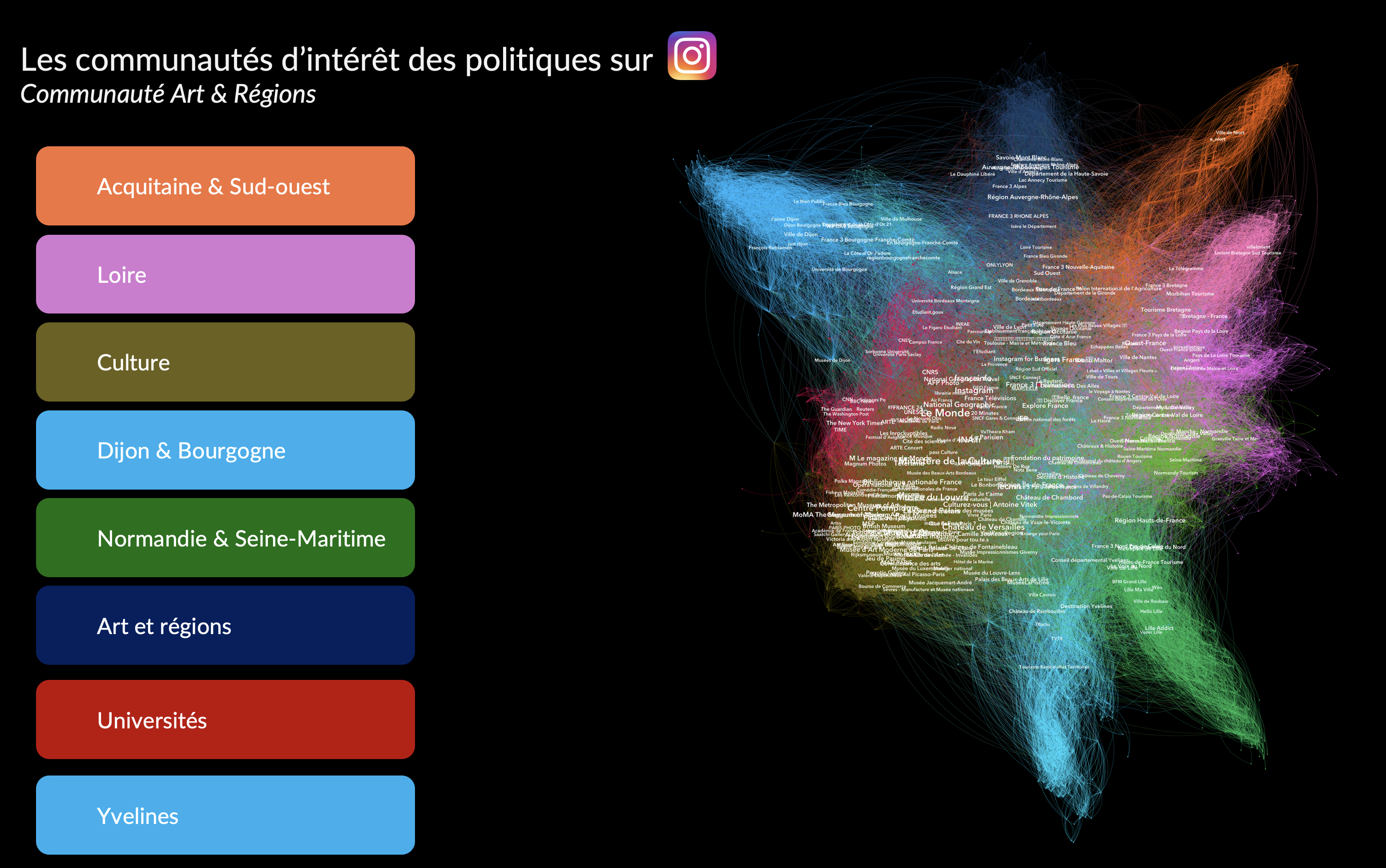
On Instagram we find a relatively inward-looking ecosystem with activist strands. Renaissance has a stronger presence than the other parties (mainly the young Macronists of the time and the 2017 campaign), whereas the RN is much less present digitally through its activists. Apart from that, two communities isolate themselves: one on Art / Culture and Regions, which is very interesting, and one with celebrities.
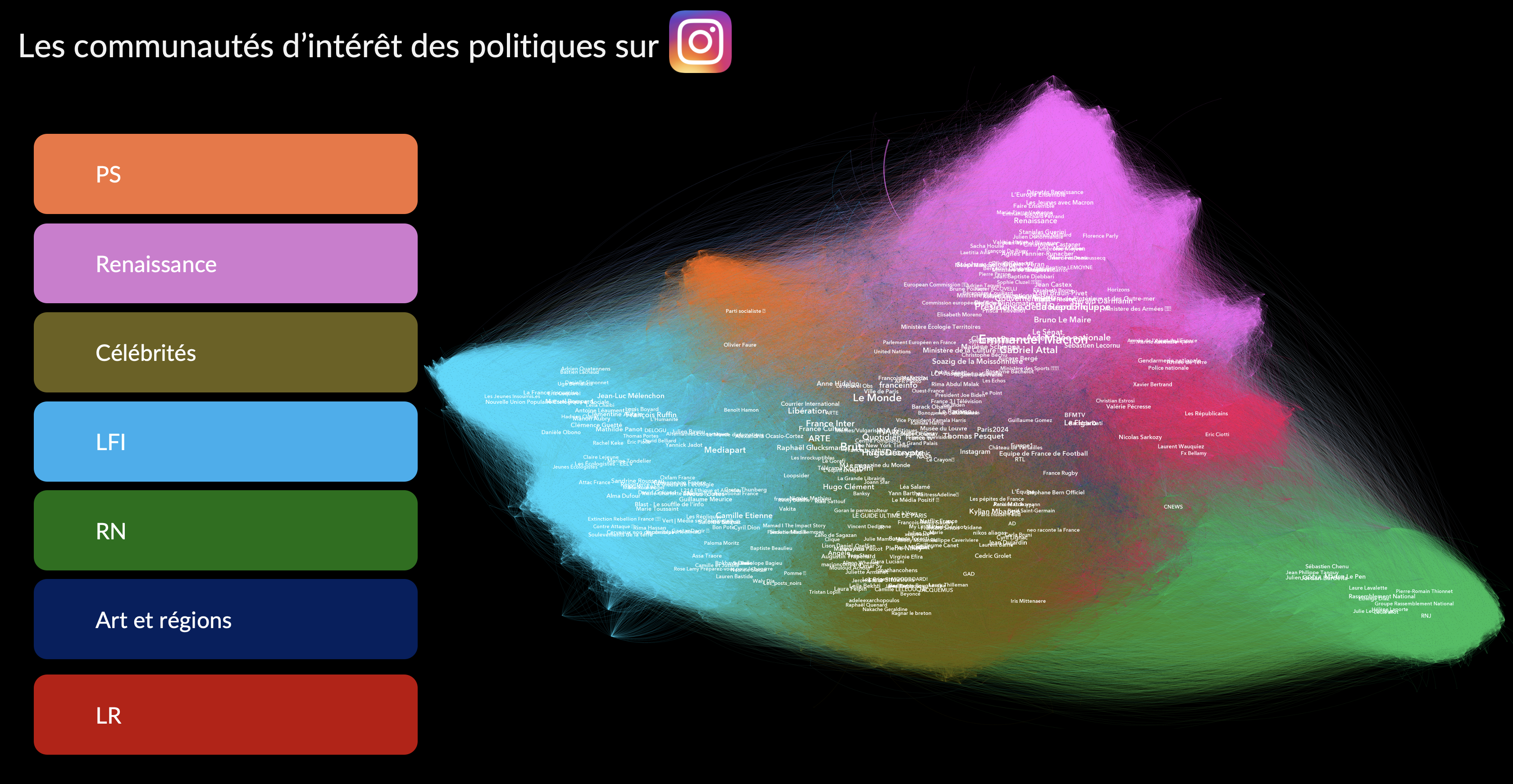
Interesting because, as we will see, museums and regions are in fact widely represented in a community that is regionally oriented. In reality, looking at the accounts, Instagram posts lean heavily towards imagery and tourism.
In the end, however, it must be said that Instagram is not a very favourable place for political communication, for several reasons:
- The audience is an activist audience that is already convinced. For some, this activist audience is also rather thin compared with other networks studied.
Objective:
- Speaking to your activists
Target:
- Campaigners
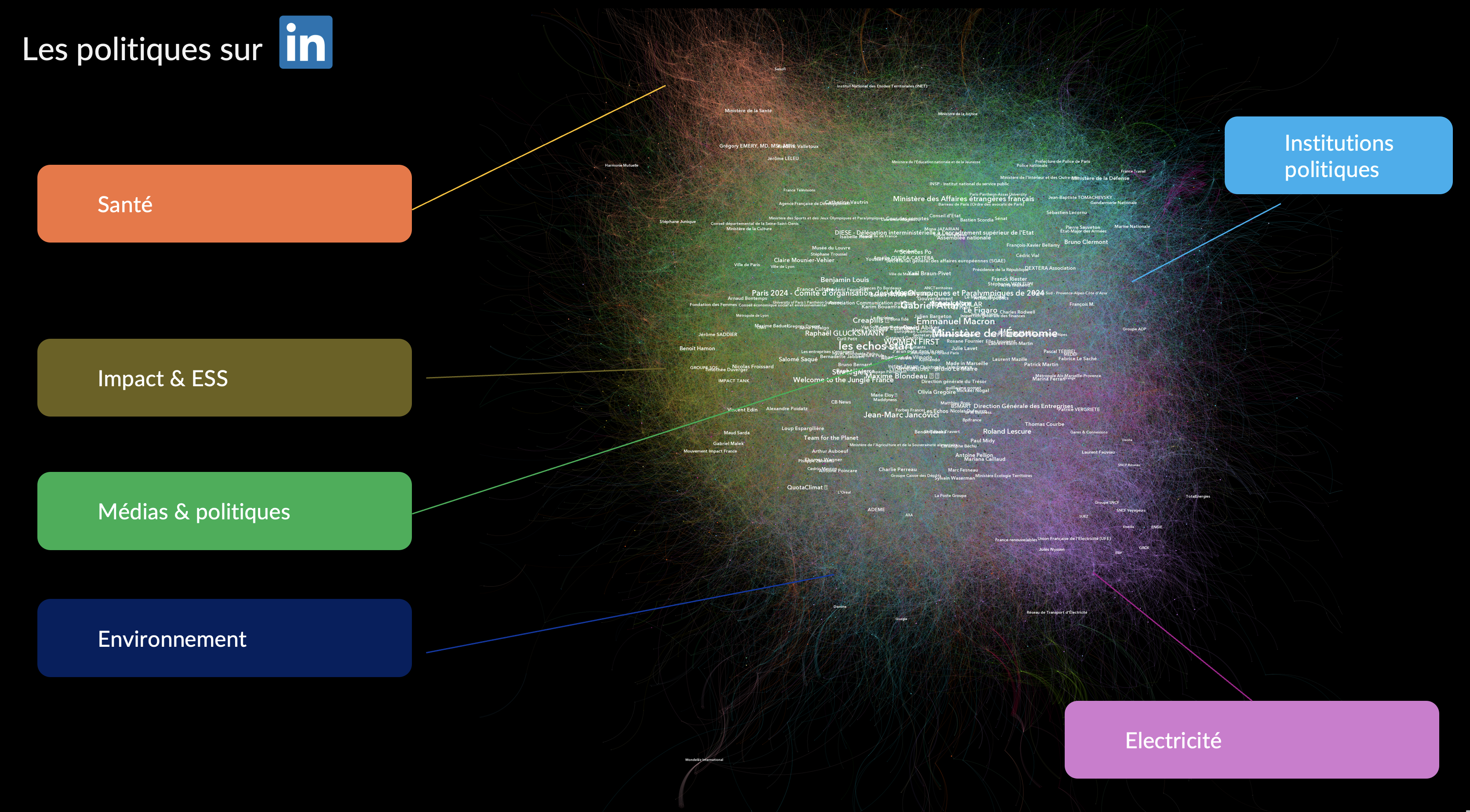
It should be noted that on LinkedIn the methodology is not the same as the one deployed for the other networks (focused on how people follow one another). It is a proprietary methodology that we have developed to identify clearly the communities around a subject, a community, a theme or a profession. It maps players using all the link factors we identified through our studies of the other networks, for which we could map the links between players.
Here we find communities with a large share of institutions, economically rooted media (Stratégies, Les Echos, Creapills), sectors with a large political element (health, energy) and also societal players (all the impact movements, NGOs and communities around the environment).
Objective:
- Having an expert message that speaks to professionals and interest groups
Target:
- Interest group
- Business circles
- Ministerial staffers
Bluesky
As a reminder, on Bluesky we had found that nobody was there apart from left-wing politicians: