


In a constantly changing media landscape, organisations and companies often face choices about their presence on social media platforms, driven above all by the fear of missing the next social network that cannot be missed. Yet in recent years it has rarely made sense to look at alternative networks, whether Elo, Mastodon, Parler or other platforms that set out to position themselves as “killers” of existing social networks.
The emergence of Bluesky, a decentralised social platform, offers new prospects and challenges, particularly in comparison with established platforms such as Twitter. The current situation of Twitter / X, marked by notable changes in its management, its moderation policy and its audience, has left room and openings in which Mastodon (in an attempted comeback), Bluesky and Threads want to play their part.
That being so, should one build a presence on Bluesky? Who is present on the platform? Is it different from X? To try to answer these questions, I analysed the most influential accounts on Bluesky and delineated the network.
Executive summary
Bluesky is a network whose follow system borders on amateurism, even though its algorithm relies on the logic of the people you follow. It is a very old-style Twitter with next to no innovation.
It is a network heavily pre-empted by journalists, with a very strongly left-wing slant. Exchanges are much healthier than on X. A few politicians are on the platform, but apart from Thierry Breton none has developed any serious presence. (44 national and European MPs, mainly NUPES, with an average of 236 followers and 26 posts.)
Activity, except among the platform's hyper-active users, is very, very low. (An average of 308 posts for the platform's top influencers...)
A network without strong thematic audience pools. No gaming community (though there is a cultural one and a few streamers), and no sports or crypto communities as strong as on X. At societal level, there are no well-formed communities on the usual topics either (transport, agriculture, health).
The potential audience pool among French speakers is around 15k. Too small for a dedicated strategy.
In short:
- From an individual point of view, Bluesky can be tortuous to join, because the follow system that shapes the experience is inadequate. The platform is, however, far healthier than X. On the other hand, debates there are virtually non-existent, or well argued and civil. It will therefore appeal to people on the left and in the centre, and much less to people on the right, who will find themselves isolated on arrival.
- From a political and non-profit point of view, the platform is almost of no interest today, since audiences remain small and the societal fabric is thin. I say almost, because there are still niche-strategy angles for PR (politicians are absent from the platform while many journalists are present) or for positioning within the left (activism is present).
- From a corporate point of view, setting up a dedicated strategy seems to me a mistake at this stage, given how small the audience pool is (15k in my view). Here too, a niche strategy can be worthwhile. It would consist of deploying a public relations strategy aimed at journalists, or strategies to position an organisation to the left. From a marketing and consumer goods point of view (B2C logic), steer clear of this network.
- From a lobbying and societal pressure point of view, the platform is of no interest whatsoever. There is no buzz mechanism and no stakeholders, so steer clear on these fronts.
In my view, Bluesky will never be a credible competitor to X. It is an interesting parallel network for individual use. But with a technology that amounts to an ancestor of X, a complete lack of thought about how the platform is rolled out and about its follow-based algorithmic logic, and a sanitised feel that pleases users but will hurt its promotion, I would bet fairly heavily that the platform will forever remain a relatively confidential or niche one. I therefore think organisations should simply reserve their handle on the platform, perhaps publish there the content they post on X, but should not have a deployment strategy for this platform as things stand.
Of course, everything can change quickly, and Elon Musk could well make a blunder on X that changes everything, but it would still take a cataclysm for Bluesky to become the new pre-Elon Musk Twitter.
Methodology and starting assumption
I began the analysis by asking whether it makes sense for organisations and companies to have a societal presence on the Bluesky platform.
As head of Saper Vedere, I focus on analysing the network as a tool for establishing a social licence to communicate or operate through key stakeholders recruited and aggregated by a digital presence. I therefore do not consider or analyse Bluesky from the individual angle (is it a good idea to join Bluesky as an individual?) or from the marketing angle (is there a funnel or conversation opportunity in adopting a strategic presence?).
I therefore set out to understand the 30,000 most influential profiles on the platform from a societal perspective, starting from a small seed list of media outlets and journalists, isolating the accounts they follow and analysing how these 30,000 profiles follow one another.
Mapping the most influential accounts on Bluesky from a societal perspective
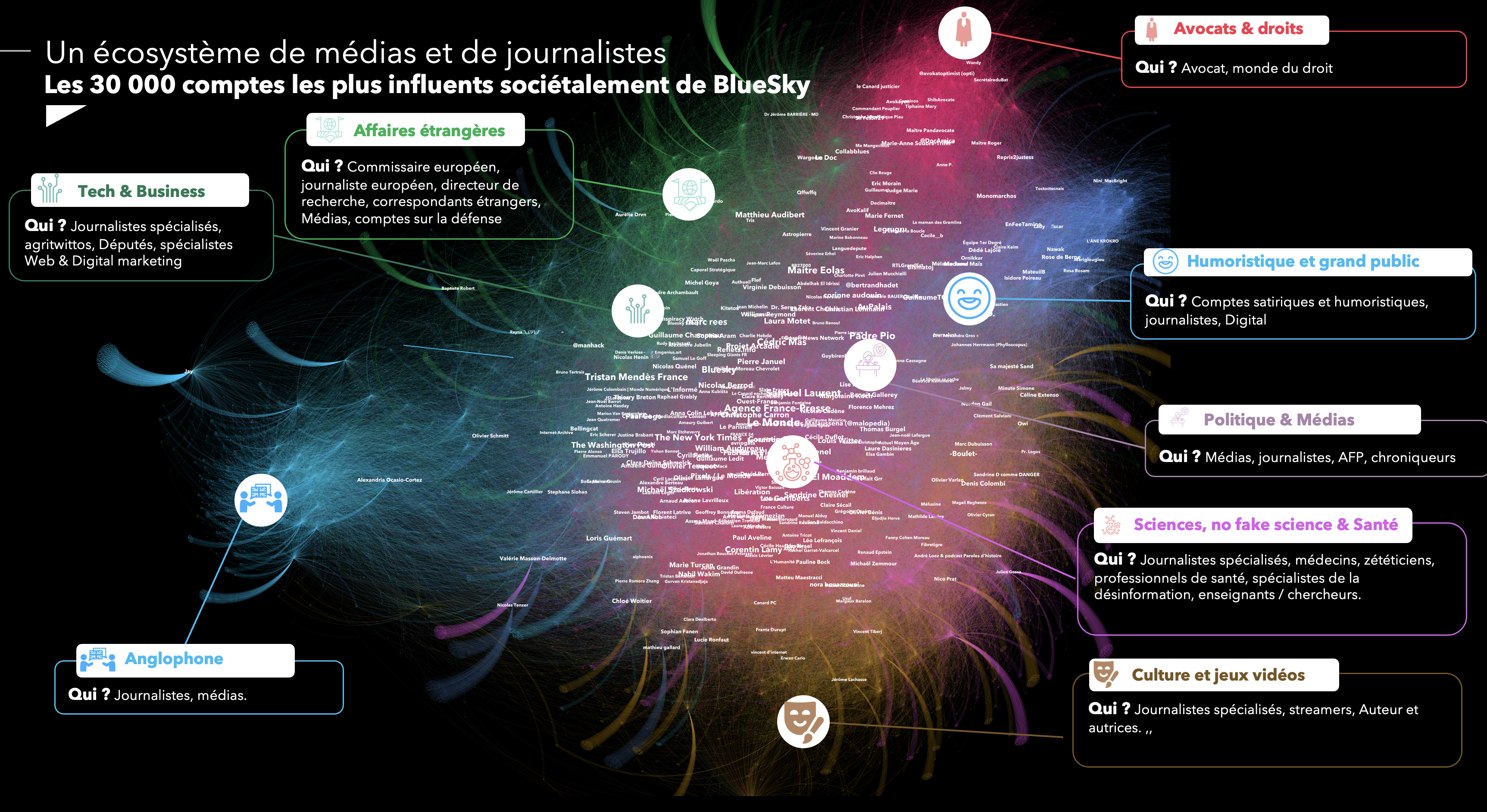
The communities found are, in order of size:
Culture and video games (6167)
This community is in fact extremely heterogeneous, and I could just as well have called it “general public”. It is made up of technology early adopters, culture and games journalists, streamers, film fans, and all the guardians and fans of web culture.
English-speaking (4500)
This community includes many people from the US followed by French-speaking circles, but also many bilingual French speakers who follow the news in English. It also includes correspondents and journalists.
Academia and specialist journalists (3830)
This community is truly the academic and scientific community, with many journalists specialising in research, science and other areas. It also includes teacher-researchers. It is not visible in the visual because it is buried right in the centre of everything.
Tech & Business (3808)
It has a strongly technological component, with journalists specialising in the web and technology, well-known accounts from the digital sphere, and accounts focused on economic topics (curiously, it also includes agri-tweeters).
Foreign affairs (3573)
This community includes diplomacy, foreign correspondents, the European bubble and accounts specialising in defence and the armed forces.
Politics & media (3465)
Mainly journalists and media outlets. It also includes analysts and commentators on political life. On the graph, it is the “lawyers and rights” community that is in fact broader than its label suggests.
Humour and general public (2830)
It includes people focused on satire and irony.
Science, no fake science & health (1826)
It includes doctors, fact-checkers and sceptics (zététiciens).
A very sparse network
The first thing that strikes you in the ecosystem is the lack of structure in its communities. Logically, we are looking at the 30,000 most important accounts on the platform, and yet they are very, very weakly connected. The most-followed account (Le Monde) is followed by barely 507 people. For the third, AFP, we are already down to 443 people (barely 1.4% of the 30k people who make up the ecosystem studied).
By comparison, in the Follaw panel of 18,000 people on X, the most influential person is Emmanuel Macron, with 7,297 followers among the 18,000 in this smaller sample, and Le Monde has 6,568. In short, Bluesky suffers from a major network-structuring problem that comes down essentially to several things:
- Its rollout model: offering invitation codes to sign up is interesting from a DevOps point of view, as it limits growth and creates scarcity. However, it produces a system that is still drastically short of people, and following practices are very complicated on the platform.
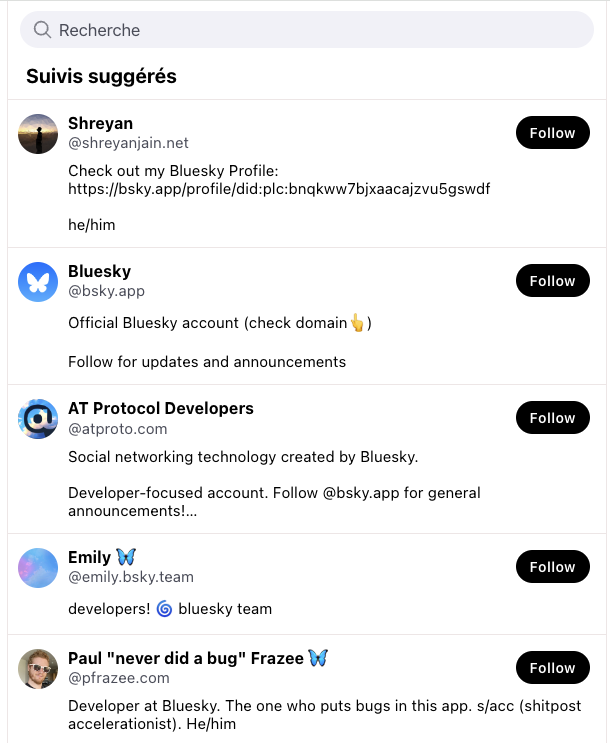
- Extremely poor recommendations of people to follow : Bluesky offers no follow system worthy of the name. One might have thought it would have integrated all the mechanisms that X gradually adopted, but profile recommendations, management of new arrivals and so on are completely inadequate. As an example, here are the profiles Bluesky recommends that I follow.
Yet unlike emerging networks such as TikTok, which base everything on the relationship between user and content, Bluesky remains a network structured around the people you follow. (Incidentally, an analysis by Flefgraph using a different, interaction-based methodology identifies almost exactly the same communities, which demonstrates the influence of relational fabric.) The quality of the platform therefore depends on the network you build for yourself. And on that point, it is still in the dark ages, with an essentially American outlook that ignores every development in relational social networks and borders on sheer amateurism. The figures leave no doubt. On average, the 30k people follow 313 accounts. On X, the average (because of people who engage in mass following) is 3,709.
Finally, how far content goes viral depends on network density and the famous degrees of separation between people (see Milgram's theory of degrees of separation). The lack of connective tissue between accounts makes virality far harder than on X, and Bluesky's algorithm is totally inadequate outside a user's own network, serving up content in English or other languages, as well as content of no interest whatsoever to the person using it. On this front, it feels like the dark ages of network algorithms, and it jars with newer platforms such as TikTok, which work almost without any influence from follower networks.
A left-wing social network
Let us say it plainly: among French speakers, Bluesky is a left-wing social network, strongly reminiscent of the right-wing social networks of a few years ago, where recalcitrant profiles rejected by X isolated themselves (Parler, Truth Social, Gettr and others). No centrist or right-wing media outlet is present. (Note that some Le Figaro journalists are, such as Chloé Woitier.) This creates a markedly calmer climate on the platform: since there is nobody on the right, there are no political clashes. Left-wing users will like that; perhaps those from other political camps rather less.
A network of journalists
All the communities are formed mainly by journalists, who have a strong presence and are very active. That presence is also essentially left-wing (Mediapart, Libération, Télérama) and centrist (AFP, Le Monde).
A network of early adopters
Having lived through a very early period of Twitter, Bluesky has a whiff of nostalgia in offering accounts of early adopters of social media platforms. There is therefore always a digital tinge in almost every community. That said, the same phenomenon can be observed on Threads.
No thematic communities at all
Thematic communities do not emerge. Today, the networks are “globish” and all-purpose. Even the community of lawyers is in fact part of the media and politics community. Where on Twitter one sees, beyond the media, thematic communities such as transport, agriculture, the economy and many other topics, they are entirely absent on Bluesky. Among the general public, the big audience providers that sports, gaming and cryptocurrency communities represent are also almost entirely absent, except in a few sub-communities. (There are gaming accounts, but they do not strongly structure the audience.) Likewise, news and analysis of the war in Ukraine could have been more visible as a community, given that the main players on this subject on X are present on Bluesky, but that is not the case.
A network where companies and NGOs are absent
Apart from early-adopter individuals and journalists, it is hard to identify key profiles on the platform, such as NGOs (Cécile Duflot embodies Oxfam and Anticor is present, but beyond that nothing emerges among the most influential accounts) or companies. The latter have secured their account handles but have no presence strategy, and do not emerge at all in our analysis of the network's most influential profiles.
Politicians have created accounts but have no presence and a meagre audience
Apart from Thierry Breton, politicians are not very influential on the platform. 44 MPs (national and European) have signed up so far, but they average 236 followers (sic) and... 26 posts. In other words, they dipped a toe in the water and never went in. The vast majority are from NUPES (mainly EELV), with a few LREM among them. As for the RN and LR, they are completely absent.
An extremely small audience pool
On average, the platform's top 30k accounts at societal level have 747 followers... The audience is currently mainly American. I estimate the maximum audience an account can reach at around 15,000. (Of course, individual posts can reach more than that.) The leading French-language account by followers, AFP, is at around 14k. That remains very (too?) small to justify a dedicated strategy. The temptation will be strong to simply duplicate X content.
That completes the full, detailed analysis of Bluesky's structure. The social media world is becoming ever more fragmented, which is why it matters to have a fine-grained view of networks and opportunities. I look forward to running the same analysis on Threads. In the meantime, I am happy to answer questions about Bluesky on LinkedIn, X... and on Bluesky too, of course!
Photo credit: Shutterstock