


Find out your ranking in the ecosystem
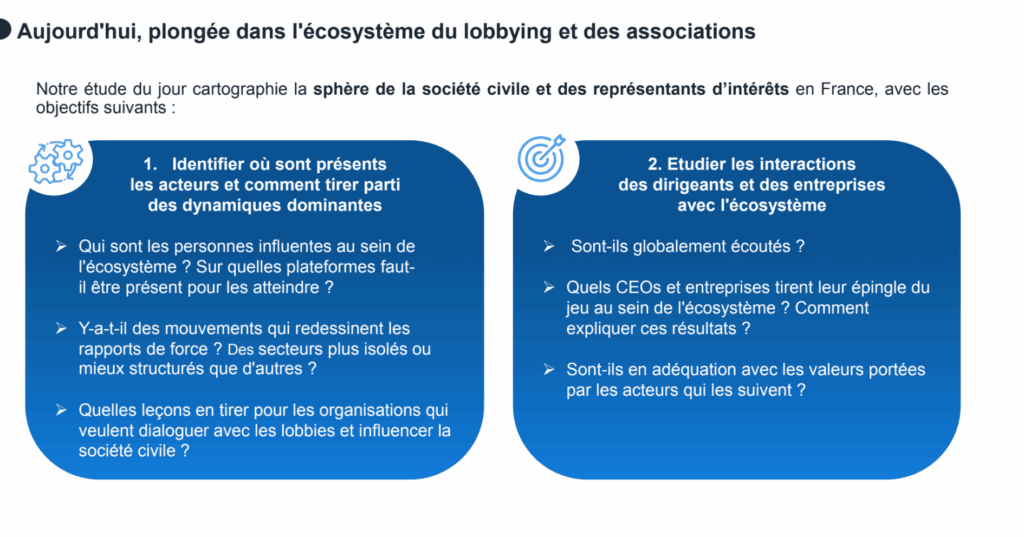
Having studied the first three spheres in previous studies, our fourth study focuses on lobbying and civil society, with particular attention to how actors are structured, their dynamics of influence and their relationship with civil society.
1. Definition and scope of lobbying
The High Authority for Transparency in Public Life (HATVP) defines interest representatives as all organisations and individuals seeking to influence public decision-making. In our study, this covers:
- public affairs consultancies, lawyers and communications agencies,
- representative associations (trade unions, professional bodies, federations),
- public bodies (local authorities, national agencies such as ADEME or Santé Publique France),
- companies and trade federations,
- NGOs and civil society associations.
The analysis is based on a panel of 3,800 organisations tracked through our institutional monitoring platform Follaw.sv.
2. Structure of the ecosystem
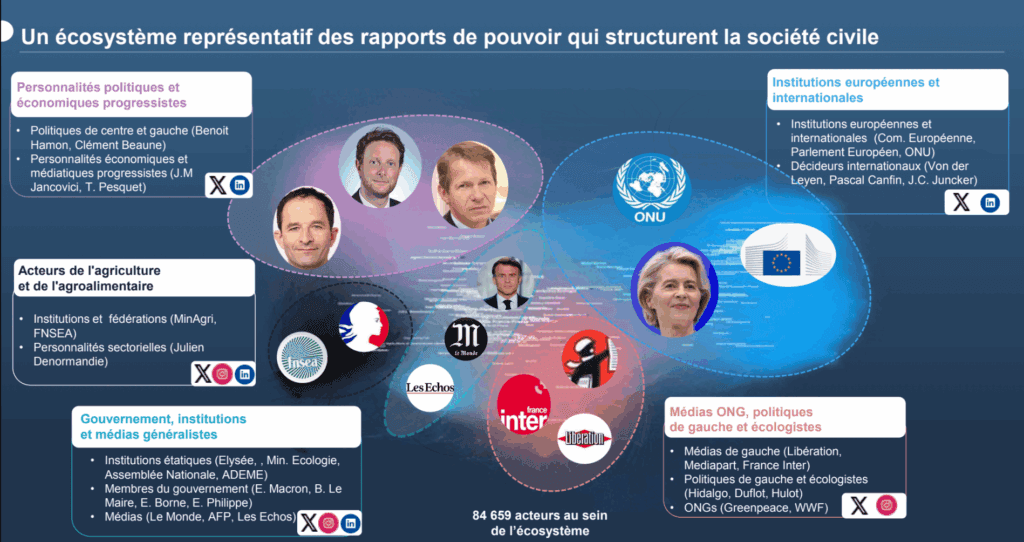
The mapping of interactions reveals several dominant communities:
- Institutions of power (French, European, international), very present on X and LinkedIn.
- Government and national political leaders, occupying a central position in the ecosystem.
- Progressive political and business figures, often challengers to the established system.
- Agriculture and agri-food, a historically mobilised and well-structured sector.
- The media community and left-wing/green NGOs, very active and influential, notably on social and environmental issues.
Conversely, some heavily regulated sectors (transport, health, digital, defence, housing) appear poorly structured and heavily dependent on institutions.
3. Sectoral inequalities
The study highlights imbalances in sectoral structure:
- Agriculture and the FNSEA are genuine spearheads.
- MEDEF holds an important place, but its overly broad remit limits its sectoral effectiveness.
- Think tanks remain discreet (only Institut Montaigne appears in the top 15).
- Health and housing show attempts at autonomy, but remain absorbed by institutions.
This lack of coordination prevents many sectors from pulling their weight collectively against political power.
4. Platforms and digital practices
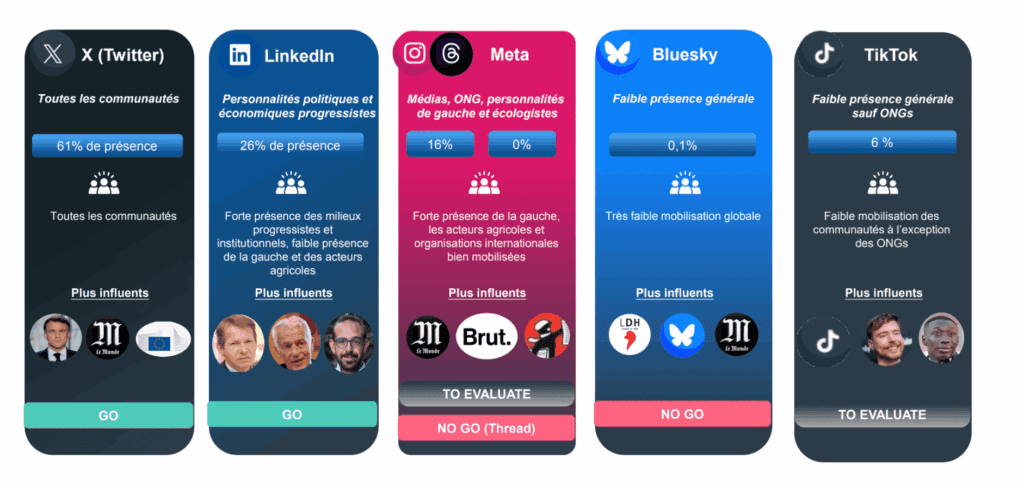
Lobbies’ presence varies sharply from one network to another:
- X (Twitter): an unavoidable platform (61% presence).
- LinkedIn: central for the economic and progressive spheres (26% presence).
- Meta/Facebook: strong mobilisation from the left and the farming world.
- TikTok: an emerging terrain, dominated by NGOs.
- Threads and Bluesky: marginal, with no notable impact.
TikTok focus
TikTok is a new frontier for lobbying.
- NGOs stand out here with an effective strategy of raising awareness among the general public, using formats suited to the platform’s codes.
- Traditional players (companies, institutions) still fail to mobilise through this channel, for lack of cultural and strategic mastery.
We therefore observe a clear divide between:
- institutional lobbying, aimed at public authorities;
- citizen lobbying, embodied by NGOs, seeking to mobilise civil society directly.
5. Positioning of business leaders and companies
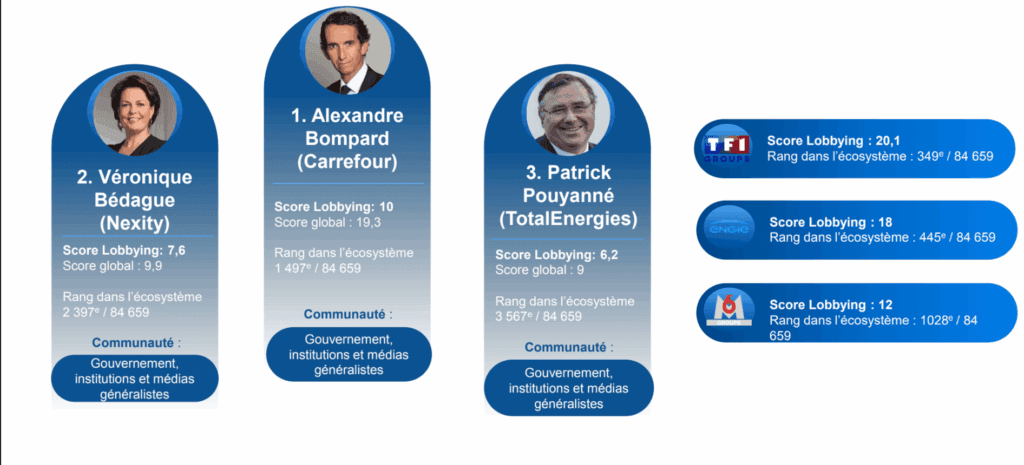
Applying our Social Impact Score to the lobbying sphere reveals:
- SBF120 executives have very few followers: the best score is only 10/100 (ranking 1,497th).
- Companies perform better than their CEOs, but often because they are media organisations.
- Committed figures nonetheless (Emmanuel Faber, Alexandra Palt, Danone) fail to break through.
- Two notable exceptions:
- EDF, influential thanks to its strategic role in energy and nuclear power.
- Dominique Schelcher (Système U), very well connected to the farming world.
Overall, business leaders and companies struggle to find an audible channel of expression in the lobbying ecosystem.
6. Key lessons
- TikTok: a new land to conquer: with stakes in monitoring, calls to action and messaging. The stakes with the general public there are very numerous.
- Lobbies with fragile coalitions: their interconnections do not reveal a solid structure. They are not currently organised to respond to short-term issues. By running from one topic to the next without building long-term assets, they do not take the time to develop into genuine activist networks.
- An exacerbated Paris-centric lens: in none of our other studies had we observed an ecosystem so centred on Paris.
- Bluesky and Threads lag behind: these platforms come nowhere near X when it comes to connecting with civil society.
- The former-minister premium: being a former minister remains an asset, both for influence in the private sector and among NGOs.
- The absence of business leaders: no business leader has managed to capture civil society audiences. That said, do they have the ambition or the need, and is it really possible? The conditions do not seem to be in place for now.
Conclusion
The French lobbying ecosystem appears both fragmented and unevenly structured.
NGOs stand out for their capacity to innovate and mobilise, notably on TikTok, while companies and trade federations remain confined to conventional practices centred on institutional channels.
In this context, the organisations that manage to:
- form solid coalitions,
- master the new digital codes,
- integrate civil society into their strategies,
will be the ones that weigh most in how political and societal power balances evolve in the coming years.