



For some years now, employee advocacy has been presented as the ultimate solution for engaging staff, strengthening the employer brand and increasing companies' organic visibility. This concept, in which employees become ambassadors for an organisation on social media, dangles the prospect of fabulous positive spin-offs, yet many companies have come unstuck with it.
Following on from our article “How to support a business leader on social media”, in which we bluntly deconstructed the implementation and the ingredients required, I will try to summarise all the statements of intent I have seen, along with the reasons why they so often came unstuck in the end. Because behind the promise of an army of enthusiastic ambassadors, the reality is often more complex: inert teams, messages disconnected from authenticity, programmes that run out of steam… The much-coveted Grail sometimes turns into a mirage, leaving communications and HR managers with costly, low-impact initiatives. So what makes these strategies falter?
I. Why is it a holy grail?
Let us be frank: on paper, it is an incredible value proposition:
Large groups have tens of thousands of employees
With tens of thousands of employees, large companies have a genuine asset: in theory, each employee is a valuable asset, an authentic voice who can reach circles of trust well beyond traditional advertising campaigns. This is true. In a tender for APEC, we had mapped the networks of each of APEC’s managers. And each had their own assets, stemming from their preferred subject, their history and their network.
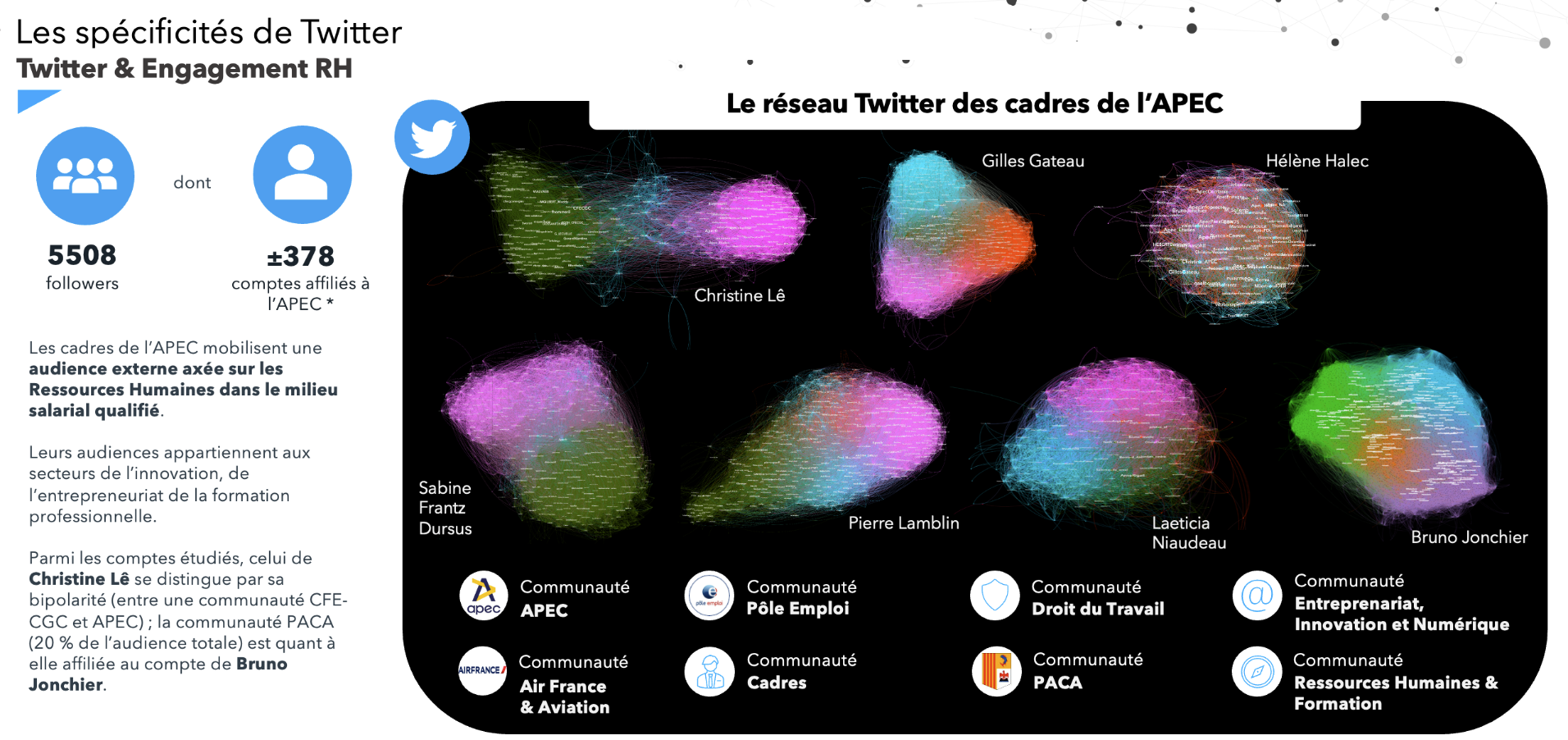
Taken together, employees have far more audience than the company, whatever the network.
They can say things the company cannot say
Still on this idea of an asset, employees can adopt a tone, a stance and other registers that the organisation cannot necessarily embody or voice. Because their words pass under the radar of the media and investors, while still reaching other employees and other audiences linked to the company’s ecosystem.
They are judged to be more authentic
And a final argument: they are judged to be more authentic for sharing an experience that resonates with their own path and values, with an audience they know perfectly: their followers or their network.
II. So where does it go wrong?
And yet good initiatives can be counted on the fingers of one hand. This leads to a clear observation: it is something you ride rather than something you create. Every presentation on the subject mentions the SNCF case, which the company latched onto but did not initiate. It is overlooked that not everyone has SNCF’s potential, and certainly not the ingredients of that very specific case. (All the more so as SNCF mostly latched onto initiatives rather than launching them.)
Unclear objectives
For a scheme to work, there would first have to be a clear goal. Most of the time there is none, other than the very existence of the scheme. It is easy to say that the goal of a scheme is for it to exist, but what do you tell the people who carry the project?
This lack of a goal leads to a lack of ambition, which means that most of the time the people in charge of the project do not have the standing needed within the organisation to draw people in. How do you attract all employees to a scheme if you sit below their manager? It is already hard enough for a business leader to bring their own team along. So what about a project manager under a social media manager, under a communications director, under a chief of staff, under a CEO? By contrast, if the goal set is clear, it is possible to go and trade results with a director and obtain a mandate that comes from the very top.
This has to go through the “quid pro quo” that the scheme will bring in. (“Through employee communications, I will help you recruit”, “Through employee communications, we will manage to sell more, which will give you extra resources”)
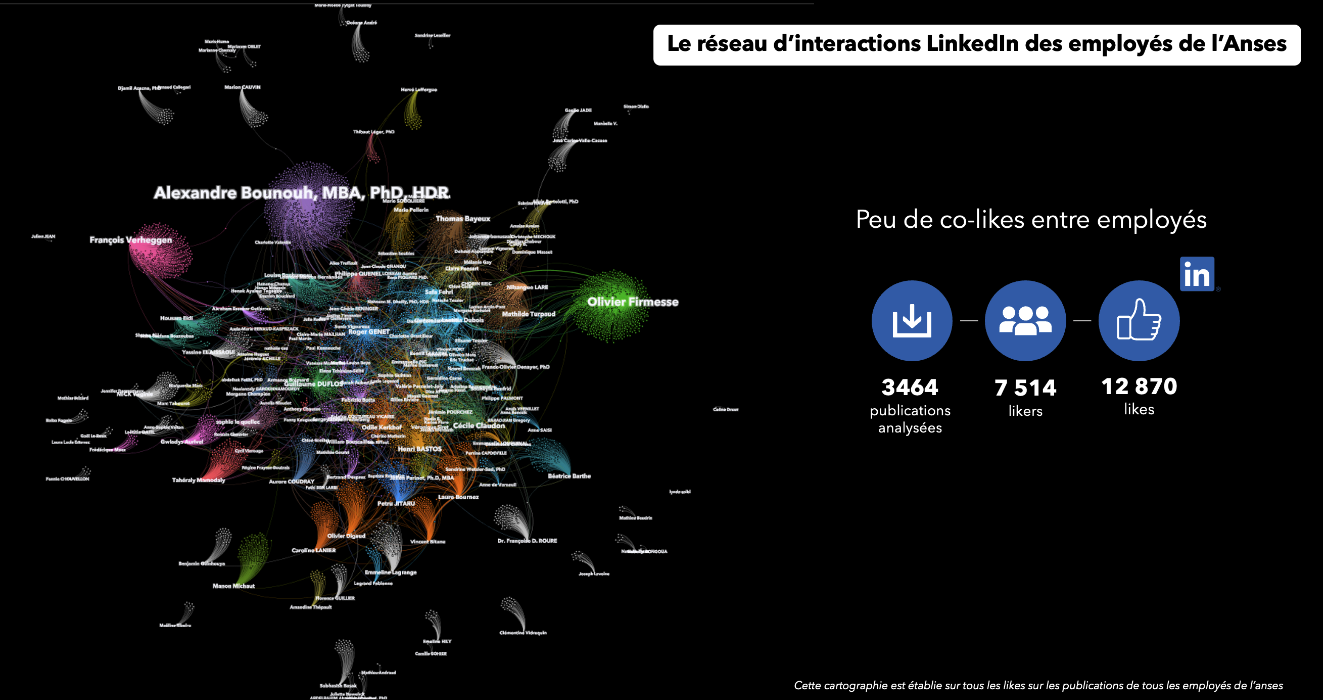
Moreover, false objectives, such as visibility or general engagement, will not get you through a director’s door. Quite simply because they are communications objectives that do not align with organisational objectives. There is also, usually, the chimera of internal influence by insiders: “Thanks to the scheme, you will be able to speak to other employees more.” Let us dispel this chimera straight away with an example we can make public (but which illustrates all the assignments on which we have provided objective data), namely Anses. We took the 7,514 likers among the employees at the time of that case (2021) to see how they interacted with one another. And the lessons were:
- That most employees are dormant. And even more so when it comes to the organisation they belong to.
- That outside communications or HR departments, LinkedIn interactions are isolated. Each colleague likes posts independently, depending on their team.
- That on LinkedIn, the infrastructure is not conducive to building a community, including one around working for the same company.
In short, without a goal, the project will die a natural death, to the sniggers of just about everyone who has seen it.
Beware of targets
Rank-and-file employees do not reach the general public, unless they are able to create content that interests it. Most of the time, they only reach people from the trade (because they went to the same school or talk about their work) or from the sector. (They work on the same things.) It is therefore illusory to think that an engineer at Bouygues Construction will reach the general public.
Lack of alignment of interests
Those who launch these projects often see a complete mismatch between what the company expects and what employees care about. There has to be a “shared interest”. But no, an employee will not communicate without seeing what is in it for them. Following this logic, quite a few companies have tried to build schemes worthy of 1990s McDonald’s, namely the employee of the month. The difference is that the good employee at McDonald’s knew he would become the restaurant manager if he carried on like that. Here, it amounts to setting up a competition with no goal, no bonus and with the dishonour of being the biggest teacher’s pet among a field of teacher’s pets. Models of this type are generally:
- Competition: the actors vie to win the same prize. Is it right to introduce rivalry into a scheme whose aim is to build a coalition?
- Collaboration: the actors collaborate in a partnership logic to reach a goal with no reward. Is it right, in a work setting, to enrol people in a scheme with no gain and only losses?
- Mutualism: the actors have a relationship in which each benefits equally from the other. It does not work because there is no scenario in which one employee benefits equally from another.
The most objective model is coopetition, a hybrid strategy combining cooperation and competition. A goal is set to be achieved together, from which each party will benefit if everyone collaborates. Interests are thus aligned.
Beyond this interest, employees' fear of social media also has to be defused. They have understood perfectly well that social media can be a problem for a career. There is no longer a case like that of June 2013, when a Taco Bell employee was photographed licking tacos and broadcast it on Instagram.

Even so, we have all seen the story of the 23-year-old fired over a GIF in the company WhatsApp:

And there is no shortage of examples of social media missteps that bring a very strong reprimand.
Organic means organic
Organic requires creating interest and authenticity. The perfect metaphor was explained in our previous article: the very minute a CEO delegates the writing of their posts to a third party, most of the interest in the posts goes with it, insofar as authenticity goes.
Not only is a person who talks only about their company no longer authentic, but they will eventually have no audience. Quite simply because if someone is interested in the company, they will follow it. But nobody is interested in someone who talks only about their company. So a principle of content selectivity is needed to have a genuine angle.
To sum up: the very minute an employee becomes a robot repeating the company's words, they lose one of the two assets they hold relative to the company: authenticity. All that remains is their audience. And that audience drains away as the editorial line talks only about the company and across many topics.
Employees switch off at the end of the day
If SNCF has been able to have so many employees active on social media, it is also because there are train enthusiasts among them, or people who care about the notion of public service.
This passion is not present in every company and every sector. Equivalents might be aviation, fashion and beauty, video games, sport, gastronomy, art, culture, politics and, to a lesser extent, law. Outside these sectors, it is hard to find people who can embody a sector outside working hours.
The invisible costs
The invisible costs are often overlooked: employees' time is not free and the programme as a whole has a cost. Without an objective, these costs become ever more visible and the project's appeal diminishes. They must be considered beforehand, which is not always the case.
III. So do we stop?
That said, this bleak picture does not mean an employee advocacy mechanism is impossible. The ingredients seem to me to be:
- Ideally, target your own sector, and one that has an element of passion.
- Set a tangible operational objective and identify the interest shared with the teams.
- Give employees complete freedom and avoid wielding the stick when they make a mistake.
- Plan for the invisible cost.
A good employee advocacy campaign follows these steps:
- Identify what already exists. This means looking at all the employees who speak up authentically today and seeing how they talk about the company.
- Define a collective organisational objective. Bring the business leader on board by making them look closely at the objective.
- Set a to-do not list, the opposite of the to-do list, which sets out the problematic items and the things not to do. Anything not on the list can be done. The to-do-not list changes every year.
- Find a shared interest so that there is something to gain. And, of course, share the common objective.
- Aim wide at the start, because there will be many drop-outs.
- Share resources and good practice while keeping everyone informed of the objective indicators in order to mobilise collectively. Leave employees complete freedom over the resources and how they make them their own.
- Change the objectives and the participants over time to avoid fatigue.