



Senior executives at large groups increasingly feel the call to speak out and the importance of being visible. While they sometimes still fear the aura, the visibility and the large audience of the traditional media, social media feels like a “safe zone” in which to embody their role as their company's natural spokesperson. We decided to share our knowledge on the subject by isolating the tectonic shifts at work.
They overlook a key issue, however: it goes beyond simple institutional communications. It is about putting into words the concrete impact of decisions, sketching out prospects, and becoming a beacon for employees in the night of their daily work. None of this is simple. So we will stretch the potential of speaking out on social media.
Summary
- On the connection between social media and CEOs, we are in two different worlds: CEOs who have no clear objectives, and organisations that lack the process and the habit of handling these requests.
- However, this will become a compulsory step for the next generation of CEOs to secure their objectives on the three “extras” (extra-financial, extra-legal and extra-reputational).
- Their view is often truncated. Either over-interpreted or under-interpreted. The problem lies essentially in their own information habits, or in the ecosystem of note-writing around the people they meet, which points more to traditional media than to social media, skewing how they form their opinion by
over-interpreting their own personal circle instead of grasping the circles that matter for the objectives pursued. - The key objective is to find a “shared interest” and an “objective achievable through social media” around the primary axes of the CEO's medium- and long-term action plan.
- The method must have a well-established target and set an editorial line that matches the target and the objective pursued.
- Indicators must move beyond “social media” indicators that do not speak to CEOs and should not speak to anyone. (Besides, they are only a guarantee of disappointing results.) The number of posts on a subject, the number of engagements, the number of biased impressions in the trillions: it is bullshit and it will never speak to intelligent people who have to take a decision and understand the factual basis behind it.
I. Two different worlds
- There it is. The executive has taken an important decision. They understand the value of communicating in their own name. They are certainly not the first, and they certainly have a benchmark in mind. (Nicolas Hieronimus, Michel-Edouard Leclerc, Xavier Niel.) They then summon the communications department, or even the group's social media manager directly.
- There it is. It has come out of nowhere (or from an overall plan with a strategy that stood no chance on paper), but the communications department or the group's social media manager receives the request. The group has to communicate.
Normally, we have just witnessed an alignment. Both sides are ready. It is a Tinder match. Except that, in fact... no.
- On one side, we have someone who is used to managing their entire organisation chart, their daily routine and their decisions on the basis of their skills and experience. They have ascendancy. A legitimacy built day to day. In their own fields, the CEO goes down to the open-plan floor and crushes any junior in the company on any assignment. Except that, in reality, in this field they know nothing. They have never done it before. They were never taught it. They read only the traditional media. They are unable to give guidance downwards, especially when they are being spoken to about engagement, reach and lots of Franglais words that mean nothing to them. (Rightly so.)
On the other side, we have a communications department. There are three types:
- Those who have always considered, in the food chain, that social media were beneath them. Social media? The internets? That is down the corridor, with the team in the open-plan office. For them, it is total trickle-down. Social media gets put on the assignment, making it clear that the person in charge of it will handle it. Quickly, contact is made with an agency out of budget leftovers, to make sure the in-house person does not mismanage it.
- The others, who have always kept an eye on social media with a glance. Generally the smartest of the types. They knew they had to be able to talk about it, but above all must not pretend to master it, for fear of being labelled as “handling the internets”. They will steer it themselves, taking it on as a challenge.
- Those who came up through it and ultimately extricated themselves to reach the head of communications. Needless to say, they are not going to stumble on the social media step just as management finally deigns to devote some time, legitimacy and strategic interest to it. Another possibility is that they are in fact already running the social media communications of all the managing directors of the group they represent.
While there should be alignment, in the end there is none in this story. They are not used to talking to each other and general practices are not standardised. Anyone working in legal, management or financial matters is used to being in touch with the CEO's assignments. But on the extra-legal, the extra-financial and the extra-reputational (the three “extras”), it is total fog.
In short, there are general processes for these fields that are relatively well codified. And everything is fixed in time (quarterly financial results publications, known trial dates, etc.), whereas in the societal field anything can change overnight (a change in a law or a decree, a reputational crisis, but it has a direct or critical impact).
II. The CEO
From what we have typically come across on these kinds of assignments, we have noticed certain typical patterns (though it should be said that we are dealing in caricature, or a composite of things):
1. They have no objective
They work from a checklist or from intuition: you have to post on social media. They have no idea of the purpose, other than that you need an “aura”. An aura is not an objective. Even in brand building and “branding”, nobody in marketing accepts a brief like that. However, the field is new: the personal brand has not yet been codified or theorised. Even so, it must meet the same general requirements, namely defining an objective, for a target, on a specific channel, with key indicators.
2. They compare themselves
A corollary of the previous point, but as they have no objective, they will set benchmarks. In times of uncertainty and lack of knowledge, there are two models of CEO: the “visionary” and the “comparer”.
- The visionary lives in another world (which either becomes the new world or is an unreachable
parallel universe). - The comparer will compare themselves with benchmarks that are always higher than themselves. A continent higher, a more global dimension, a model that cannot be reached.
Paradoxically, it is easier to talk to a visionary than to a comparer. The comparer will also be in another dimension, but will objectify whether it is possible. (So much so that it is impossible to argue with them, because the answer would be “but you are not such-and-such a player”, a sign of total exclusion.) The visionary is looking to find out whether their vision can be carried forward or amplified through communications.
3. They have little time
In both cases, it is always worthwhile to have an external party who “objectifies” things. But 100% external, that is, someone who dares to say things. The average attention span is 15 minutes. This is because the CEO is used to being asked for many decisions that must be taken quickly. After 15 minutes of presentation with no decision to make, they are elsewhere.
4. They have a method and an instinct
The advantage is that if they have got where they are, they are mostly brilliant. They know how to judge the extent to which the person in front of them will be useful to them or not. They are “sharp”. If the first 15 minutes go in the right direction, the rest will follow.
5. They have friction points.
Behind the shell, however, they have problem areas. Things on their to-do list that are complicated. The whole challenge is to “scratch” at those areas to identify their friction points.
6. They look for indicators
Once the action plan is in place, the main problem arises: social media indicators mean nothing and are total bullshit. 2,000 mentions? 3 trillion impressions a month? What does that mean for an executive? Nothing.
7. They value consultancy
They are used to internal politics and to people who are afraid of taking decisions. So they will value and enjoy outside input with a fresh, detached and neutral eye. And this despite the fact that in 85% of cases their own team would have told them exactly the same thing had there been no power relationship.
8. They misjudge the power of social media
Their view of social media is biased, either through over-interpretation or under-interpretation. This is down to the excessive importance of the traditional media, mainly through their own way of reading the news, but also through the narratives the media put out about social media. Conversely, they overvalue the weight of the media. They have the “media” score or have read the article themselves. The people CEOs meet have been given a briefing note on them based on their press appearances. (Although these notes are increasingly fed by social media and other open data.)
III. The method
What method can be used to reduce the uncertainty in this kind of project? We have isolated the main steps:
1. Understanding the general opportunities
Anything is possible with social media. However, there are already a number of things for which there is evidence of a possible “model” or “framework” in which the probability of achieving results is higher. Today, social media essentially make it possible to:
- Reaching one's sector.
- Making people want to join the company.
- Reacting quickly to the news.
- Building a first-circle audience around the company (suppliers, sales staff, employees, the sector) and relying on it to extend that base.
- Influencing the political sphere
- Communicating to employees.
2. Understanding
Instead of rushing towards meaningless social media indicators, it is important to understand the CEO's agenda. What is their five-year plan? What sub-objective is needed to reach that objective? What transformation must be secured among stakeholders? How can you be sure that the change of ethos is known to the key stakeholders who will collectively decide whether the transformation has succeeded? Who is the organisation's audience? Does it match the ecosystem that has to be addressed for the plan?
All this makes it possible to know “what could be achieved through social media”. In short, the idea is to offer a “shop” of possible actions that fit the overall plan and for which a social media component is feasible.
3. Setting the right objective and, above all, the right indicators
This understanding phase lets the CEO choose the objective of their choice from the “shop”. It lets you tell the CEO: “I will help you reach this objective with the tools at my disposal”.
Above all, the most important thing is to provide the right tracking indicators to make sure results are delivered. Important at this stage: never provide an engagement or visibility indicator from social media:
- They mean nothing with regard to the objective pursued
- They are the “reward sweets” that the platforms give us
- These indicators tend to be always falling because share of voice on LinkedIn and elsewhere shrinks over time.
You need to open your mind to the indicators by plugging into other things they can be linked to: revenue, recruitment, journalists, and so on. Today, every discipline generates data that can be plugged into other systems. That is where the challenge lies.
4. The content
Then comes the moment of roll-out. Every CEO and every organisation differs on many counts. The key things, however, are:
- No exaggerated personalisation of the CEO. Nobody cares about the CEO's life. What is interesting is the CEO's “personal” angle on their subjects (the themes or issues related to the company, the sector or society).
- Key visuals. You need real visuals that have a conative function (they catch the eye), a contextual function (this is where I was) and an explanatory function (this is what I mean).
- Key tags. You need to identify and tag the key players in what is being said. This makes it possible to take the message beyond the “first circle” and into other spheres.
- You need a precise target who is the “decision-maker on the objective”. Otherwise you quickly end up in a “Martine at the seaside” that thrills nobody except well-behaved employees.
- Avoid flat agency content. As with AI, flat, disembodied content with no substance and no interest produces no effect. Or else you fall back on traditional channels and communications, but with the same effects.
4. Channels
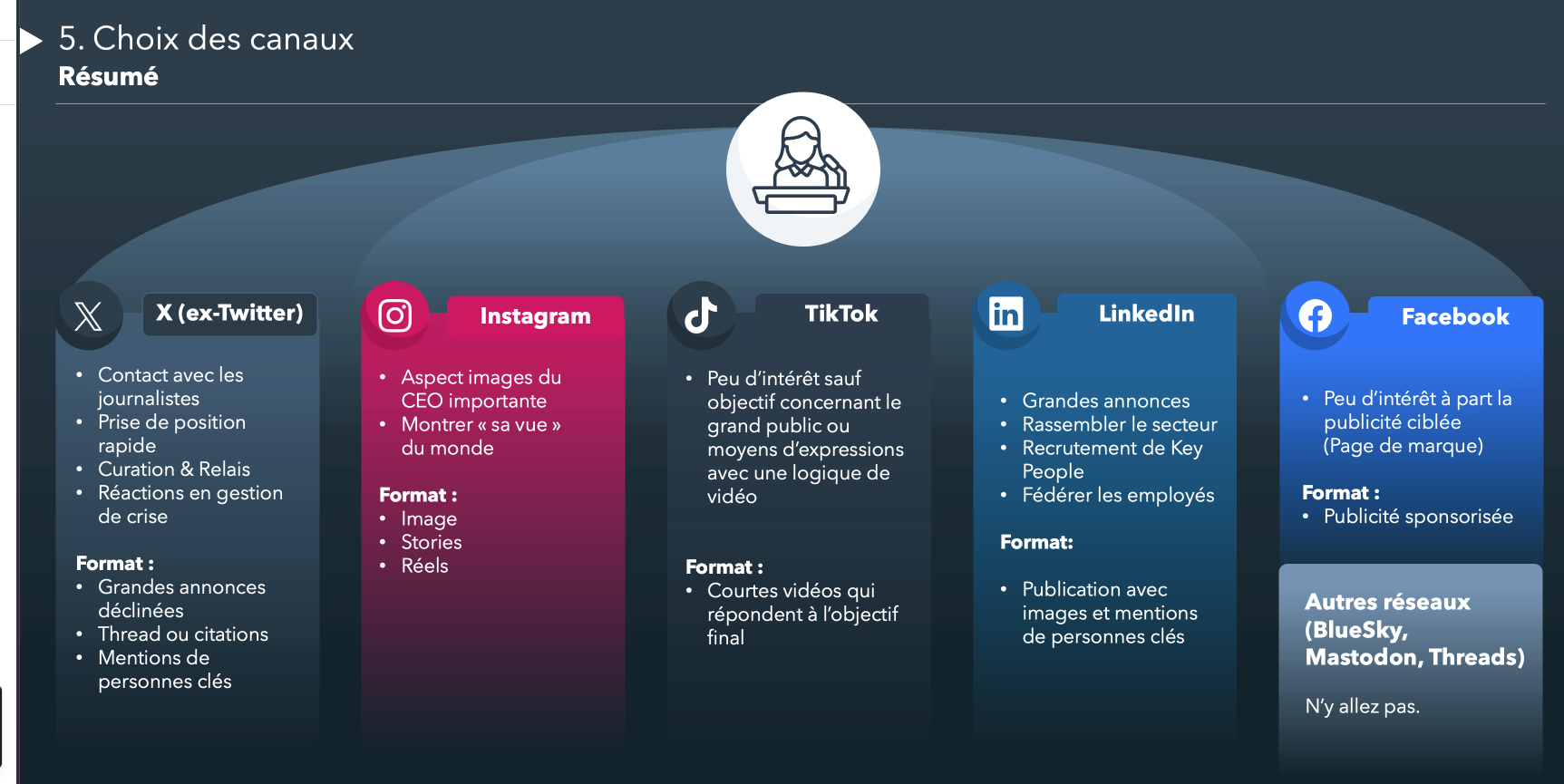
On channels, it is important to tell yourself that anything is possible. When will we see a CEO on TikTok to show their voice? They would certainly be unique. And an executive's reputation is built through antagonism or uniqueness. But if you want to reduce uncertainty, here is a summary of the “safe” channels.
5. Using the indicators to correct course or to prove the added value
It is important, but reporting on the fields is extremely important. From the outset, if possible, set the indicator objectively at T0. Logically, if you have devoted resources, time and measurement to it, T+1 will always be better than T0. But it will also let you see the variables on content and channels. Indicators, if poor, are simply a sign that adjustment is needed, not a casting error in the first year. If, however, nothing changes over 2 years and the results do not follow, the problem is the person. But if you have hit your indicators and objectives, you will have something incredible for good: your CEO knows that through social media he or she can achieve their objectives. And that is priceless. But it does come with budgets!