


Since the 2024 US presidential election, which saw Donald Trump return to the White House, many users have been turning to alternative platforms such as Bluesky. This decentralised social network, designed to give users more control and avoid the polarisation of big platforms such as X (formerly Twitter), has seen a massive influx of new sign-ups, notably political figures, journalists and influencers. This migration, driven by concerns about content moderation and freedom of expression, raises the question: can Bluesky become a credible alternative to the social media giants?
We wrote a piece at the time on the fact that Bluesky was not very interesting:
A year ago, we published an analysis of Bluesky, highlighting its limits in terms of structure, audience and strategic relevance. We had concluded that, despite a calmer atmosphere than Twitter/X, the platform remained too niche and too little innovative to justify a dedicated strategy. We then recommended signing up as a precaution without investing further.
But now the platform seems to have a fresh influx, with 1 million users in a day and a total of 20 million users. So we decided to look at it again, taking all the users in our Follaw.sv panel.
Summary
In the end, Bluesky is clearly growing, with a doubling of interesting players. The platform has picked up all the researchers who discuss their research subjects. The exchanges are therefore mainly cool-headed, expert content. There is still very little political presence, even though the narratives deployed are nonetheless very left-leaning. Right-wing players are almost totally absent. On the other hand, technically the platform is still quite a way behind.
Organisations with cool-headed content aimed at research-minded audiences (economics, health, environment and others) should establish a presence, given how impressive the number of researchers is. Moreover, quite a few journalists and media experts are there and can be good relays for corporate communications.
We will have to see, however, whether the exchanges last over time. The fact that there is something of an “echo chamber” phenomenon could discourage users. On the other hand, France, like Germany, has communities of interest on Bluesky, even though the platform has mainly exploded in the United States.
A broader, more structured ecosystem
As a reminder, previously we started with a tiny community with very disparate interests:
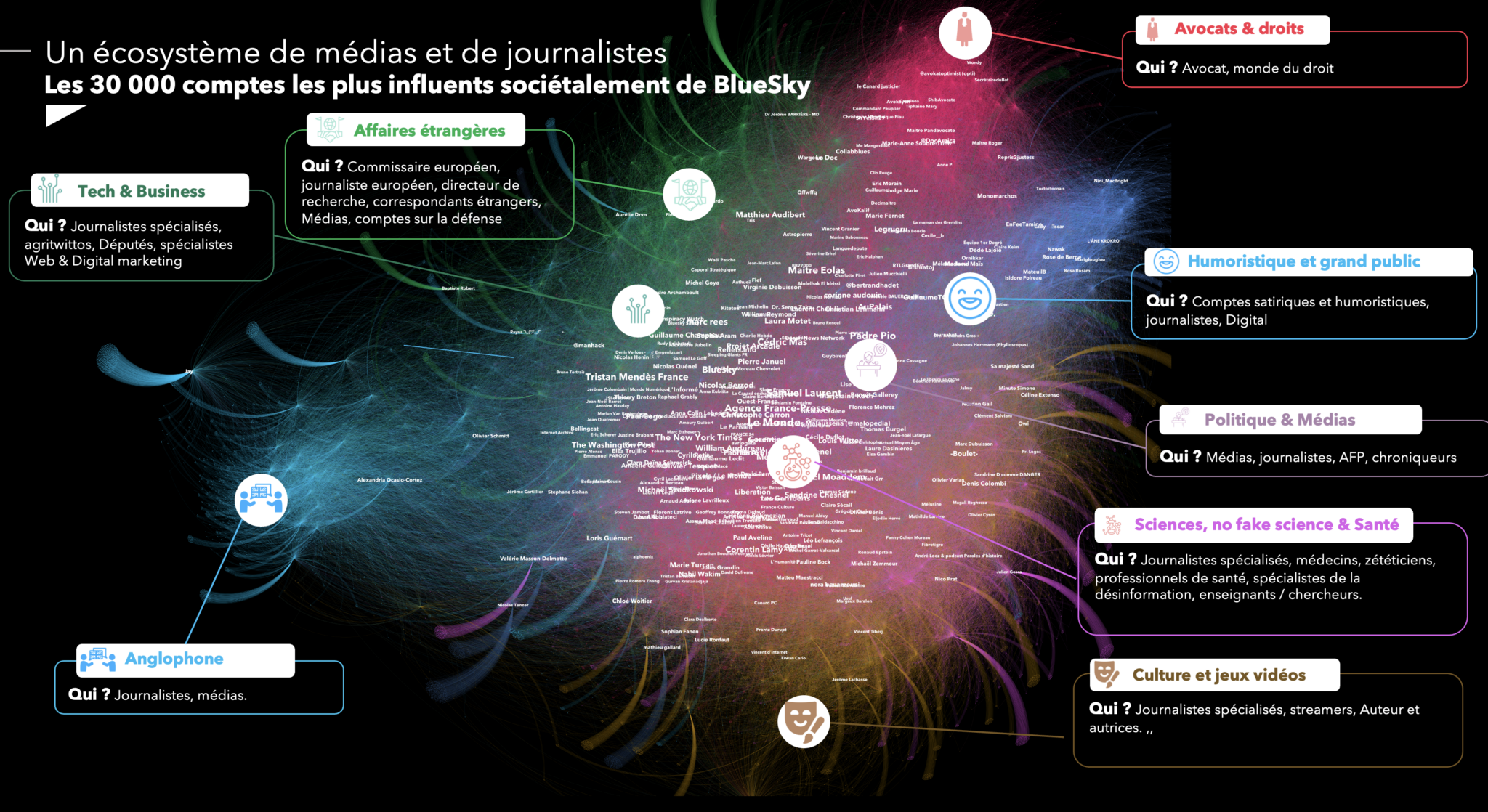
This time, the ecosystem is twice as large (more than 60,000 users followed at least twice by the players in our panel)
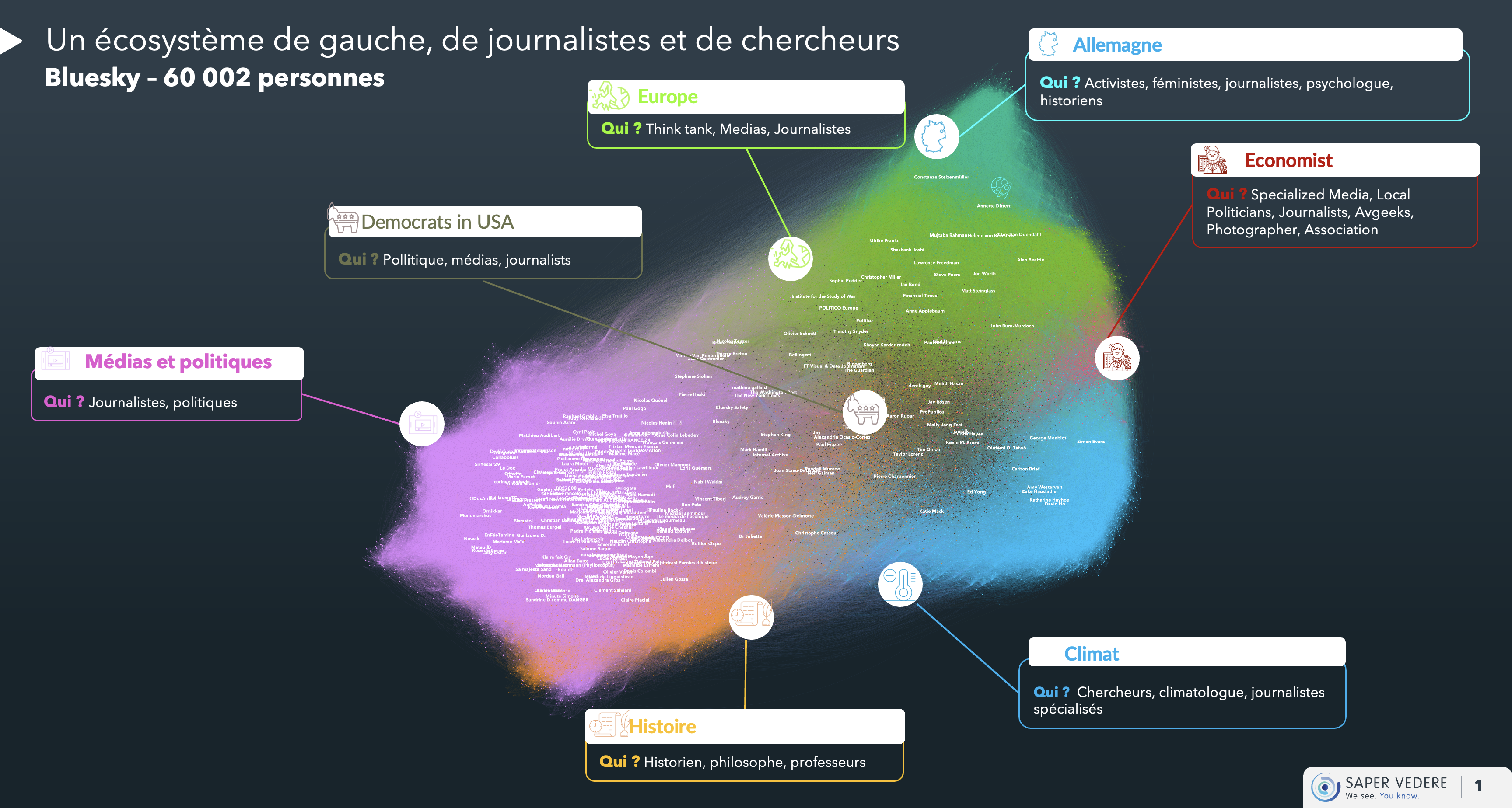
Still very left-leaning, with all the players grouped into one media and politics community.
The platform is still very left-leaning and has very little right-wing presence. There is clearly a shortage of politicians compared with X.
The Lawyers and rights, culture and video games communities do not stand out. The players are still there, but they are within the “Media & politics” group.
An impressive and very wide presence of professors and researchers
The most obvious and most impressive thing is the number of researchers and professors in the ecosystem.
- A very high-quality community of economists at international level, with many researchers.
- The whole community around climate researchers. Accompanied by journalists specialising in the subject.
- An extremely rich community of historians too, with other researchers from a few other disciplines (political science, sociology, humanities).
Countries where Bluesky is bigger
Bluesky clearly has more impact across the Atlantic, in the USA and Canada, following Donald Trump's victory. Beyond these countries, Germany clearly has a strong presence, as it emerged from our panel via the European routes. Many European think tanks are also present.
Technical capabilities still well behind
Even though Bluesky is advancing technically, notably with the introduction of multimedia features, namely the ability to post videos and GIFs, certain features found on X are still missing from Bluesky. For example, thread management for structuring long, complex discussions is not yet optimised. In addition, tools such as private messages, polls or advanced algorithmic recommendation of accounts to follow are not yet available on the platform. These gaps may limit engagement among users used to these tools on X.
So it remains extremely thin. Enough to hold back adoption of the platform.
Content like X
The content is like X when you browse the platform. The exchanges, however, are clearly more constructive, cool-headed and expert. Probably one of the reasons for the platform's success so far.