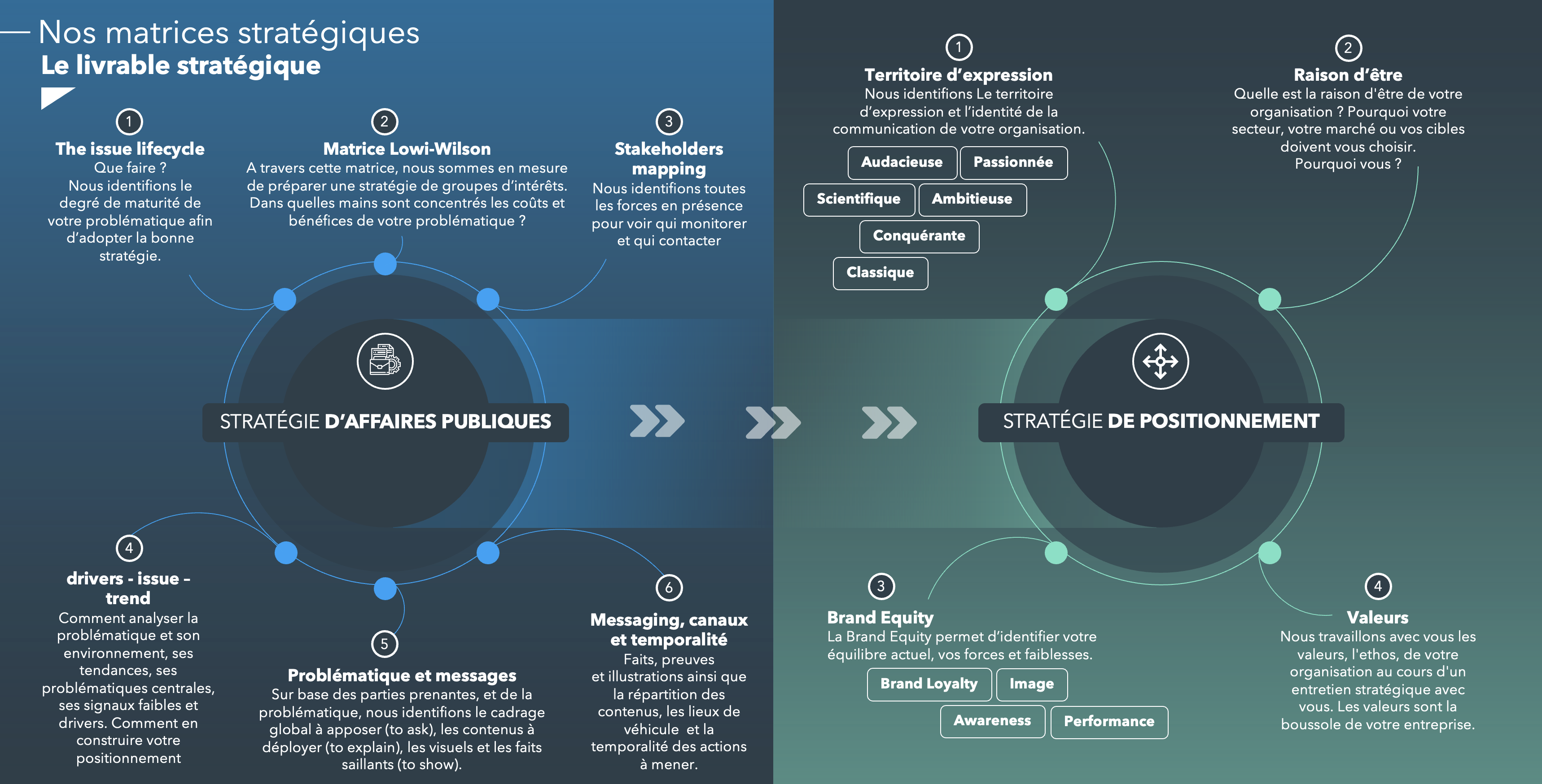
Public affairs teaching is so outdated (“Just read Hobbes's Leviathan”) that people in communications or marketing often see consultants as dinosaurs before their time, wielding a mouse across two applications: Word and Outlook.
Yet plenty of interesting theories and matrices show just how much this profession can be theorised, and how far the caricature is from reality for anyone who looks at it seriously.
I. Matrices to see where we stand
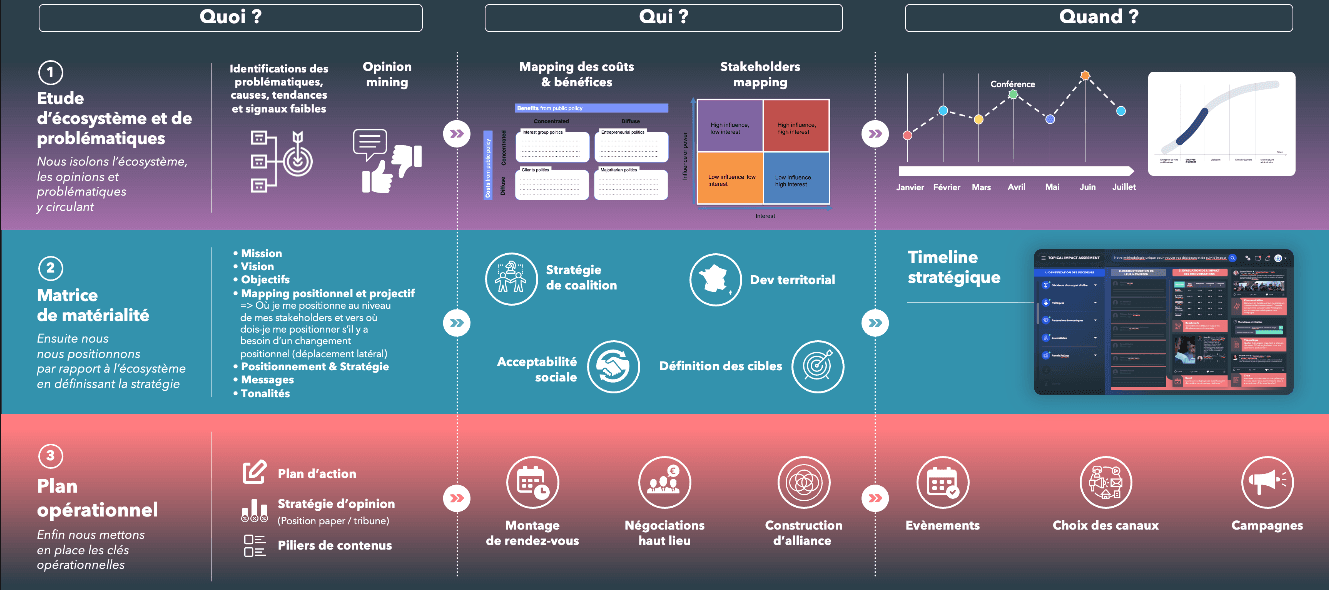
A public affairs strategy follows three steps:
- Identify needs and stakes. What societal issues does a client face? Who are the stakeholders in relation to the issues, the sectors or the organisation?
- Put a resource strategy in place: this is the who, what, where, how and when.
- Activation. The stage everyone knows, and the one 80% of clients want without the other two. And even then, far too many senior people think all it takes is having Emmanuel Macron's mobile number to seal the deal. Well, no.
a) The life cycle of an issue: this is the what
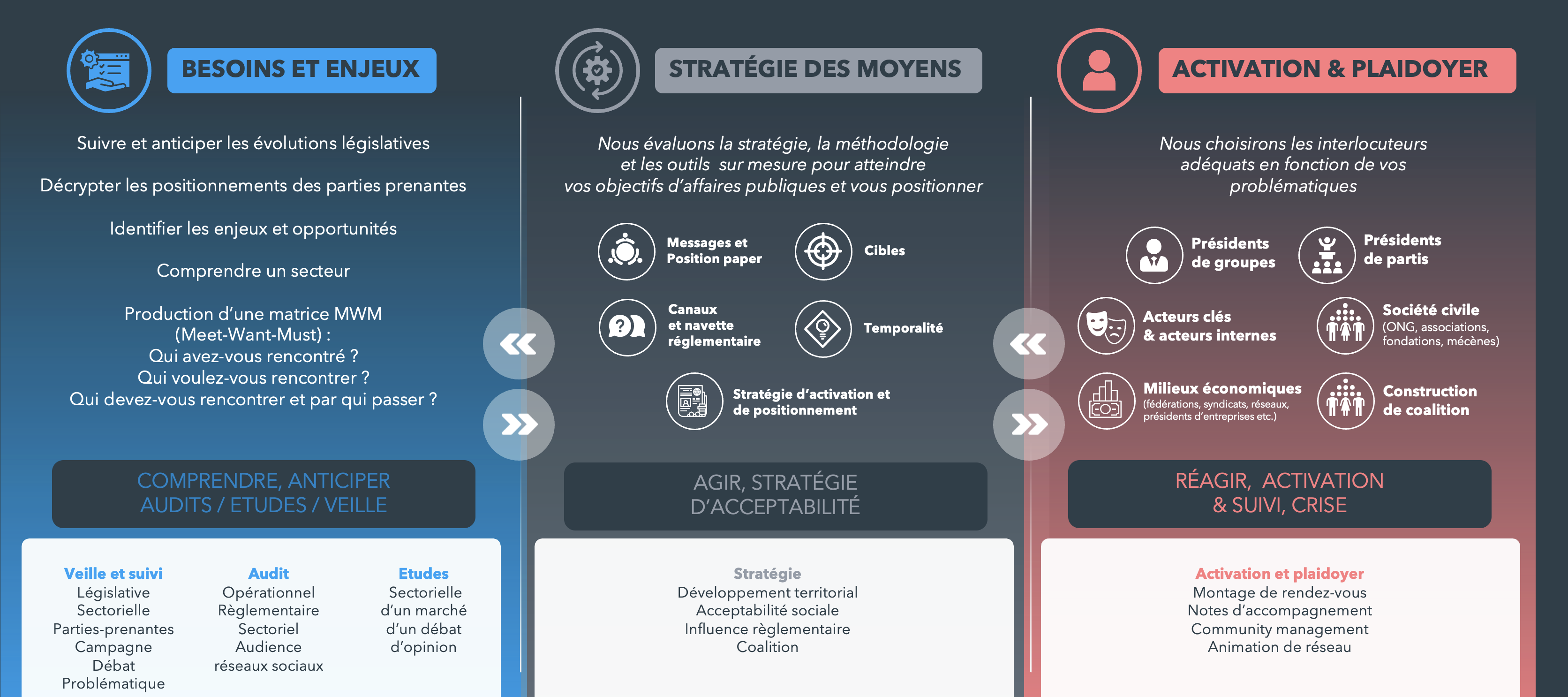
Once we have identified the issues around a client, we work out where they sit in the issue life cycle. It has 5 successive stages, which we will illustrate with an electric scooter:
- Emergence of the issue: this stage corresponds to the appearance of a new issue or problem that begins to attract the attention of stakeholders (the public, media, experts, etc.). It may result from new technologies, social or economic change, or any other factor that creates a need for regulation or political action.
• Electric scooters suddenly appear in big cities, offering a new urban mobility option but also creating safety problems and problems managing public space. - Interest groups: at this stage, various interest groups (NGOs, consumer associations, companies, unions, etc.) take a position on the issue. They seek to influence public opinion and policymakers through campaigns, research, events and more. They seek to build alliances
Scooter services will contact cities to form mobility alliances, they will try to win over business leaders, or they will try to build alliances with street furniture providers to park their vehicles. - Legislation: this is the stage where policymakers (parliamentarians, governments, etc.) start drafting bills or regulations to address the issue. Public debates and consultations are often held to refine the proposals. This is often when the lobbies wake up. And say to themselves “oh, there's a law?” and try, in 3 weeks, to respond to an issue that has been there for years.
Seeing the alliance with scooter services, the unions will oppose the pass navigo being replaced by scooters, while the scooter operator that has secured an alliance with a street furniture provider will try to ban free-floating, and so on. - Judicial enforcement: Once laws or regulations are adopted, it is crucial to ensure they are applied. Courts may be called on to interpret the laws, settle disputes and impose sanctions for non-compliance.
It is also possible to negotiate a period for appeals or a period of adaptation, as mobile operators did for roaming, for example. - Administrative implementation: this is the final stage, where public administrations (municipalities, government agencies, etc.) take charge of the practical application of laws and regulations. It includes setting up monitoring systems and sanctions, and organising information campaigns.
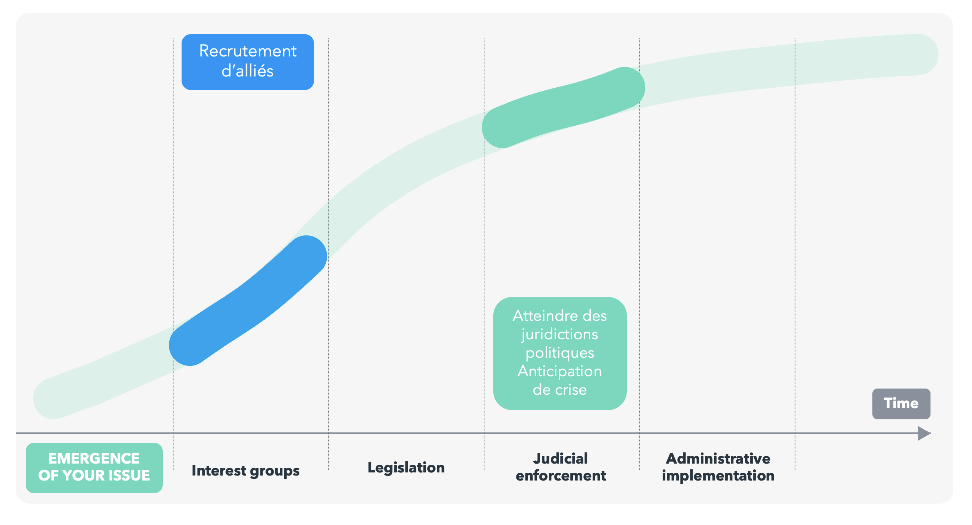
Depending on where we stand, we take the corresponding actions (raising the issue, trying to defuse it, building alliances, slowing the law down, and so on).
b) Meet Want Must: this is where we stand on the who
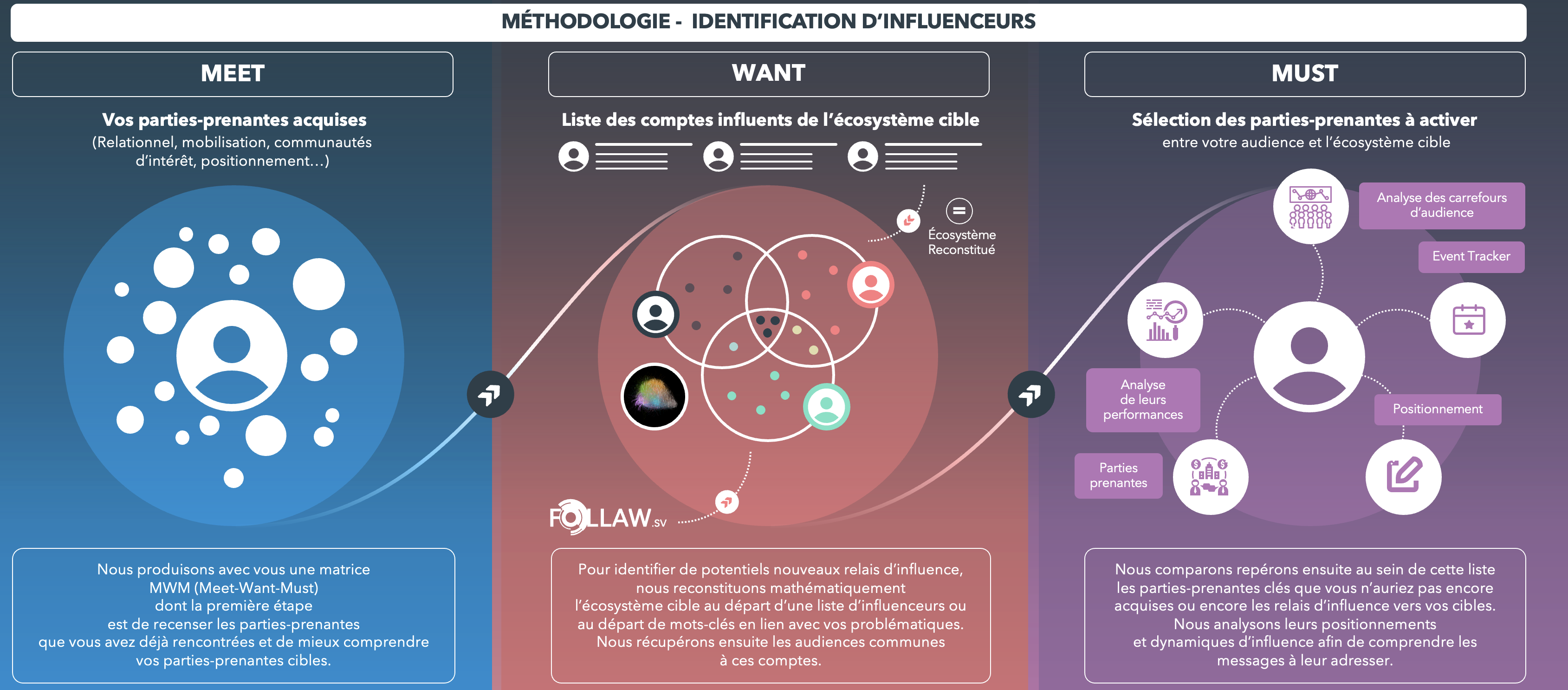
Another methodology for focusing on what is essential, put into practice here by Manon El Assaidi: the Meet – Want – Must matrix.
- Meet: this step consists of listing and analysing the stakeholders you have already met or are already in contact with.
- Want: the list of people we would like to consider.
- Must: selection of the stakeholders to activate.
c) Event Tracker: this is the when
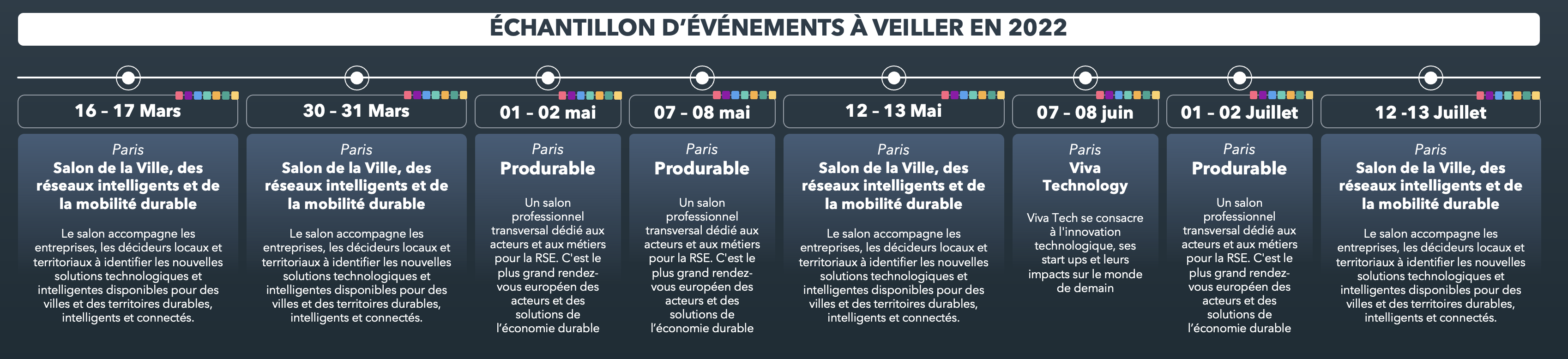
We list every event over the coming period to prepare a backward planning schedule.
II. Matrices that help with strategy and resources
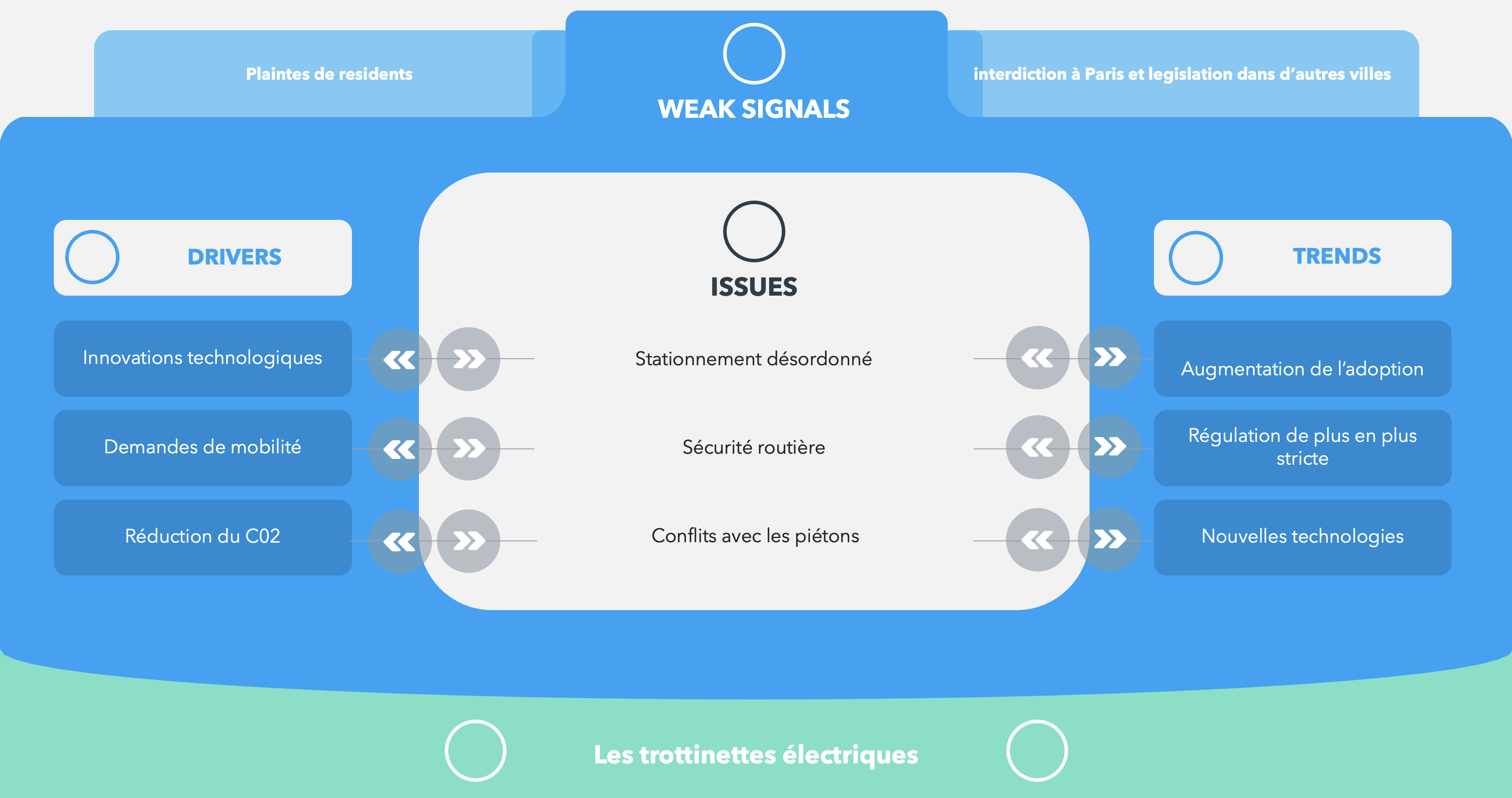
a) The Drivers / Issue / Trends matrix: the why
A go-to tool for understanding how everything hangs together around a subject, the Drivers/Issue/Trends matrix is used in public affairs to analyse and understand dynamics. It widens the field of view. For instance, you can attack electric scooters by saying they stem from a runaway technology, linking them to AI or many other things. You could also add resources sourced from China or plenty of other factors. It lets us map the entry points before any strategy is drawn up.
b) The Lowi-Wilson matrix: the how
The Lowi-Wilson matrix assesses public policies according to how their costs and benefits are distributed, classing them as concentrated or diffuse.
1. Concentrated benefits, diffuse costs: this is the policy we hate. The kind made behind closed doors and slipped through unnoticed. In public affairs, we try to brief politicians in closed circles without mobilising the media.
2. Concentrated benefits, concentrated costs: policies of this type can lead to intense conflict between the groups that benefit and those that bear the costs. In public affairs, you mobilise your whole sector to give the illusion that it will bring a great deal. All the while hoping that those who pay will be slow or ineffective.
3. Diffuse benefits, concentrated costs: This type of policy can be hard to implement because those who bear the costs are often strongly opposed, while the diffuse beneficiaries are less motivated to defend it. In public affairs, this should be obvious to decision-makers, and support has to be mobilised through petitions or broad media coverage.
4. Diffuse benefits, diffuse costs: It's WAAAR! Every resource is mobilised.
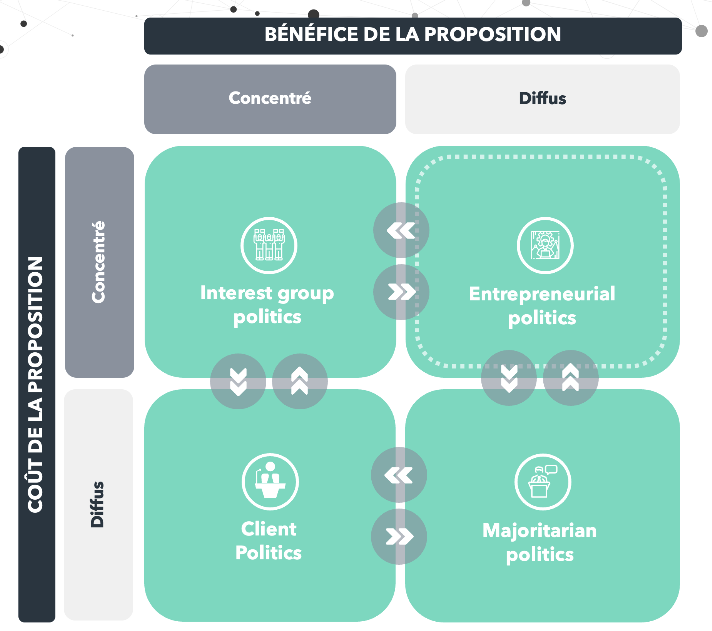
This will therefore help us find the entry point and the resources to deploy.
c) Stakeholder mapping: who do we target?
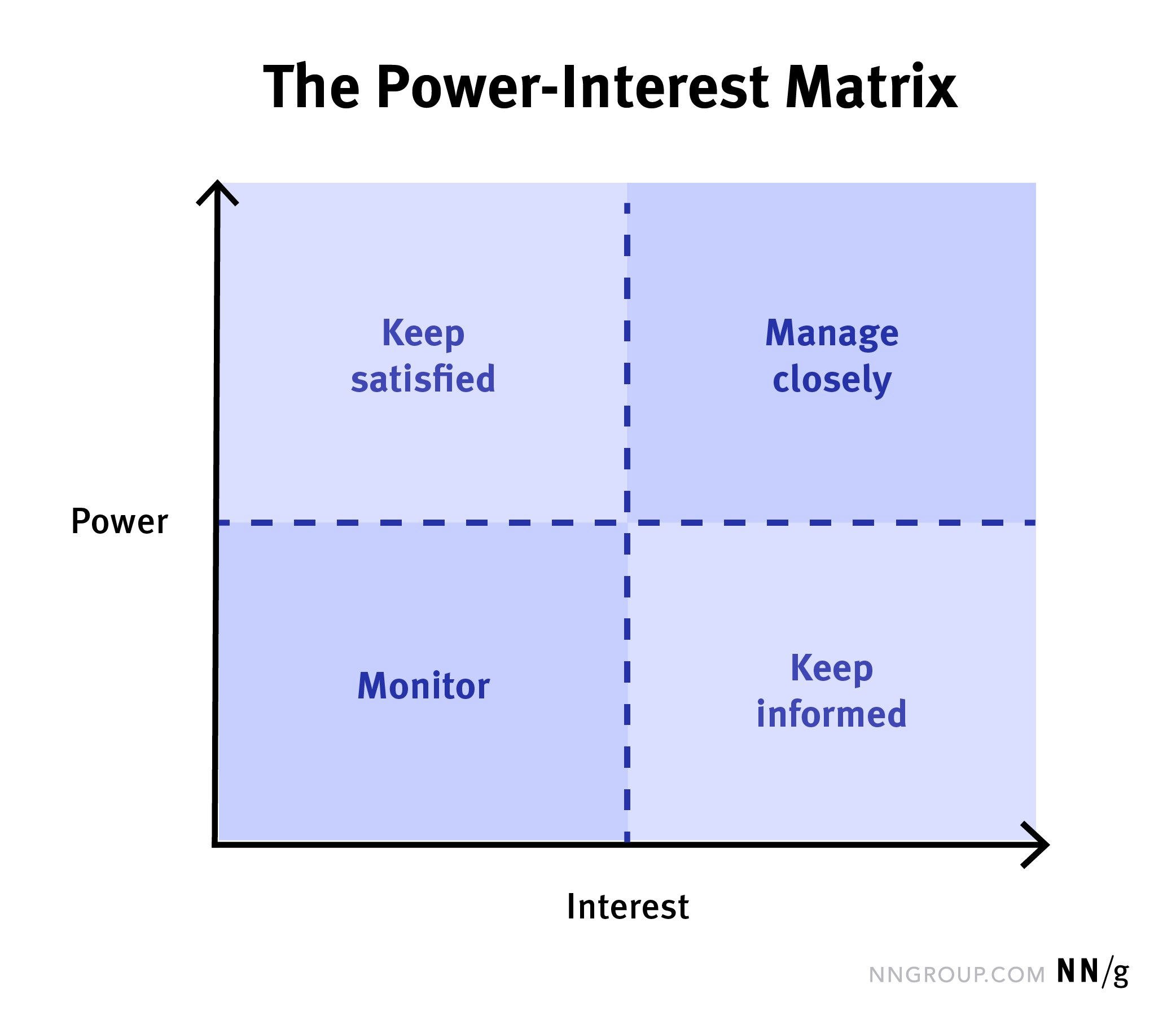
We won't insult you by explaining what stakeholder mapping is. At most, if a student happens to pass by, we will tell them that we map the people connected to the issue according to whether they hold power or interest.
III. Let's not forget the two secret ingredients: data, and using every weapon available
And through all of this, a matrix is nothing without information gathering. So we gather all the information with all the software. Then people bring their expertise and visualise it through the strategic matrices we have just seen together.
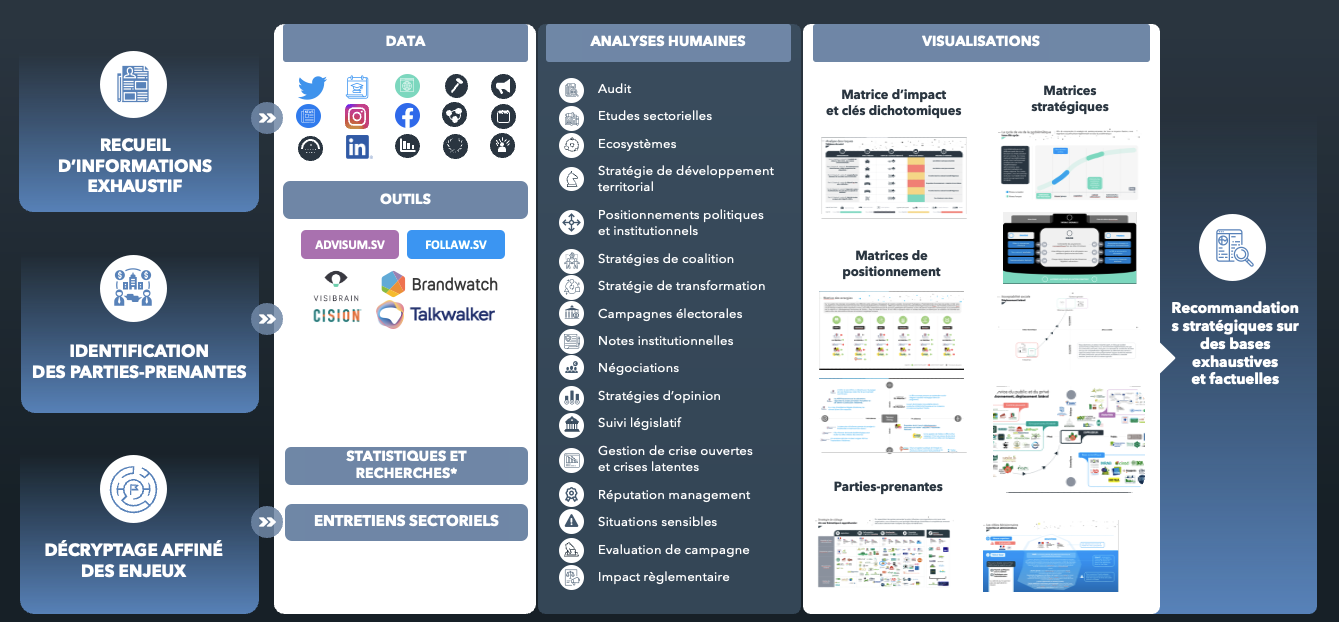
And with the public affairs toolbox alone, the picture is incomplete: the software needs upgrading. To do so, we draw on every discipline: communications, marketing and more. In short, it is all so complex that it is hard to see how anyone could remain a dinosaur in a world undergoing total change, where everything is speeding up and professionalising.