
Sommaire

Study of institutional Europe
Découvrez votre rang dans l'écosystème
Last episode of our webinar series on influence bubbles. This study focuses on the European sphere, a universe often perceived as complex, institutional, and distant. After exploring the political, media, economic, and lobbying bubbles, we wanted to understand how power and influence are structured and expressed at the European level.
What is the Social Impact Score (SIS)?
To briefly recall, we created the Social Impact Score, an indicator that measures the influence of an individual or organization on a scale from 0 to 100, across five ecosystems: political, media, economic, lobbying, and European.
This score makes it possible to concretely compare the weight of an actor within each of these universes, based on tangible data drawn from social networks and interactions between communities.
The European ecosystem: an institutional space of influence
To analyze the European bubble, we built a panel of around 119,600 actors, based on our monitoring platform Follaw.sv.
This ecosystem includes:
- political actors
- interest representatives
- economic analysts
- journalists and specialized media

This mapping reveals a very dense but also fragmented ecosystem, organized by national blocs and linguistic communities rather than by political ideology.
A still highly compartmentalized Europe of influence
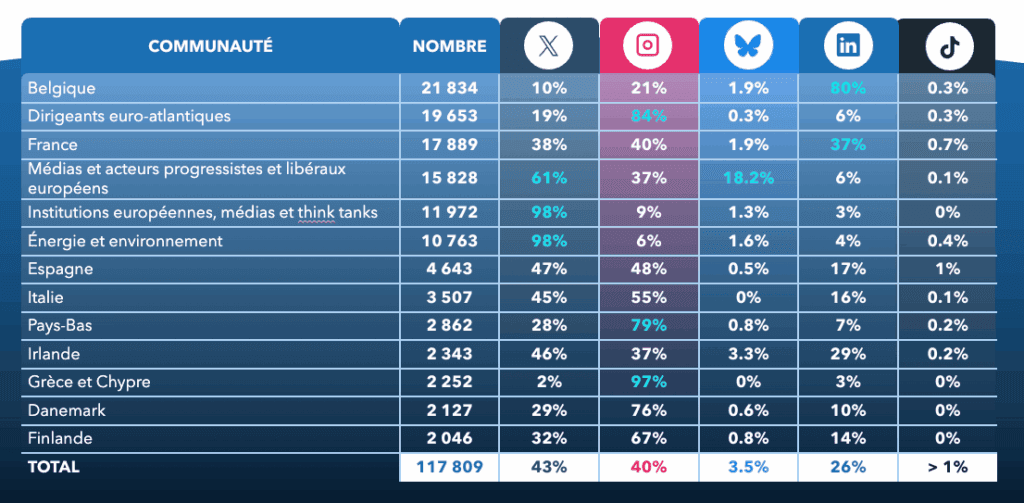
The analysis of interactions shows a strong centrality of Belgium, the geographic and symbolic heart of the European bubble. The Brussels community brings together the majority of actors who keep the institutions, media, and lobbies alive.
Around it gravitate several groups:
- a Euro-Atlantic community, marked by American presence;
- a French bubble, close to Belgium but relatively isolated, with a far-right sub-community (Le Pen, Orban, Trump, Musk, Farage);
- progressive and liberal communities, closely connected to Renew Europe and pro-European media;
- an institutional core made up of the Commission, the Parliament, the ECB, and international organizations;
- finally, more sectoral communities such as environment and energy, as well as Italian and Spanish blocs.
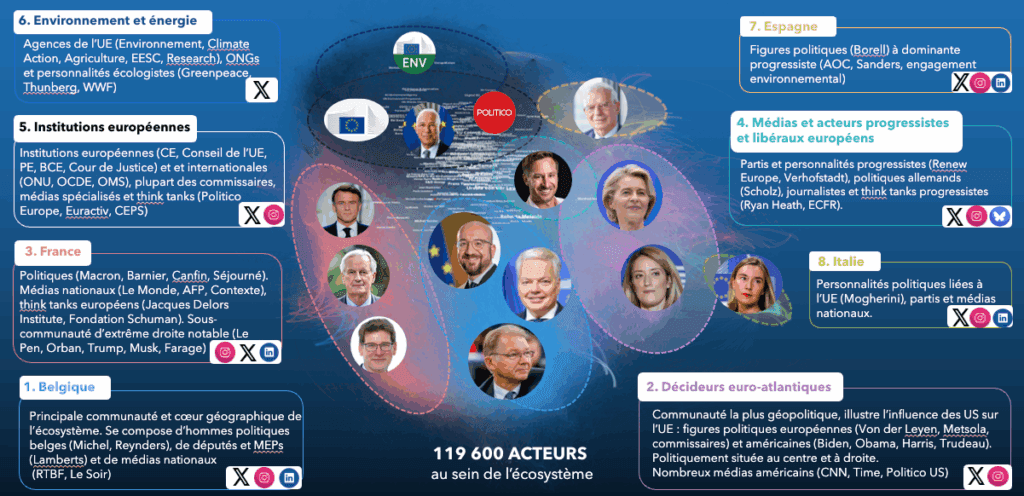
Overall, civil society is barely visible.
The European bubble remains dominated by institutions and multinationals capable of financing large-scale campaigns and maintaining a continuous presence. Citizen actors, for their part, struggle to emerge at this level.
European lobbies: between structuring and disparities
European lobbies are generally better organized than their national equivalents, but not all sectors are on equal footing.
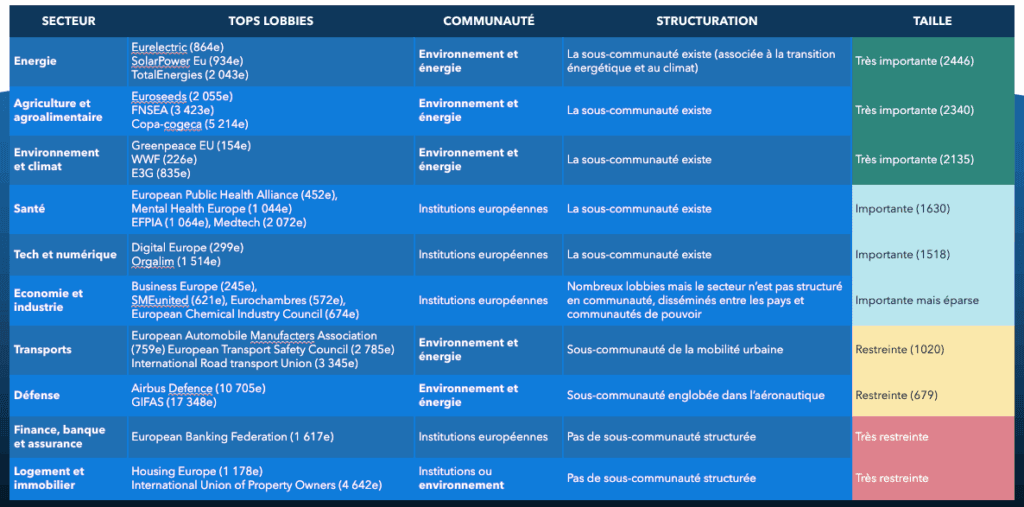
The strongest ones are agriculture, health, and technology, well connected to institutions.
Energy forms a structured ecosystem, often linked to environmental issues.
Conversely, some sectors remain weak or scattered:
- finance and insurance lack visibility (Insurance Europe is absent from the panel);
- housing and real estate are poorly represented;
- defense, though strategic, is still absorbed by the aerospace sector.
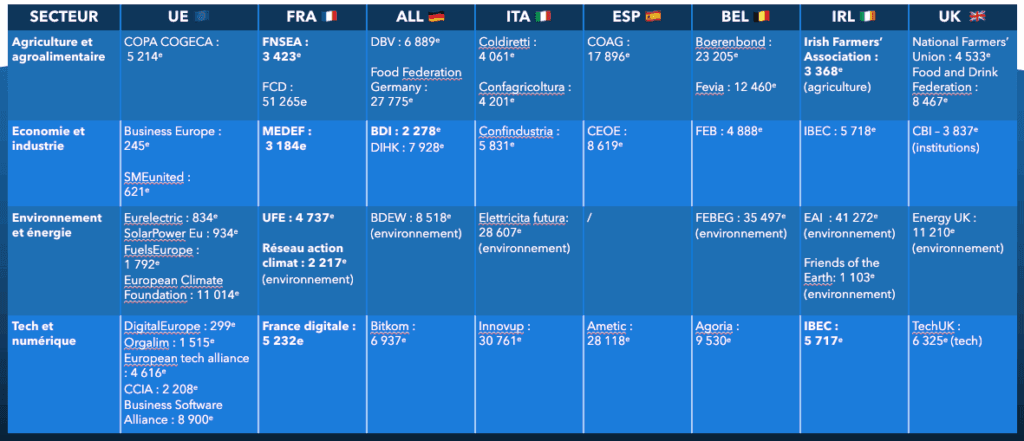
A country-based analysis shows that agricultural issues are mainly defended nationally (FNSEA, Irish Farmers Association).
Germany dominates economic matters, while France remains active but confined within its linguistic borders.
Old-school social networks
The European ecosystem remains deeply attached to traditional platforms.
The X network (formerly Twitter) is by far the most used: it concentrates almost all exchanges between decision-makers, journalists, and lobbies.
LinkedIn comes next, favored for professional and institutional relations.
Instagram, surprisingly, shows good presence, notably due to American influence and its early adoption.
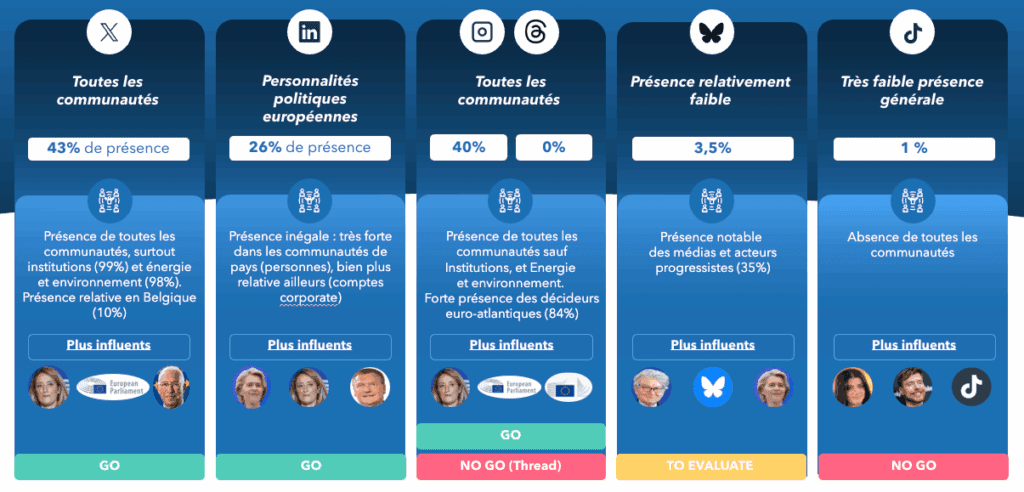
Conversely, new platforms such as Threads, BlueSky, or TikTok are almost absent.
TikTok, in particular, likely suffers from European distrust toward China.
Result: an “old-school” ecosystem, reluctant to experiment with new channels of expression.
The most influential figures
The ranking of the most followed personalities confirms that the power of influence remains concentrated in the hands of institutional leaders.
The top positions are occupied by the presidents of the Commission and the Parliament, as well as commissioners with economic portfolios.
Among the most influential figures:
- Maros Sefcovic, Commissioner for Trade and Economic Security;
- Margrethe Vestager, known for her investigations into the GAFAs;
- Mariya Gabriel, on AI and digital topics.
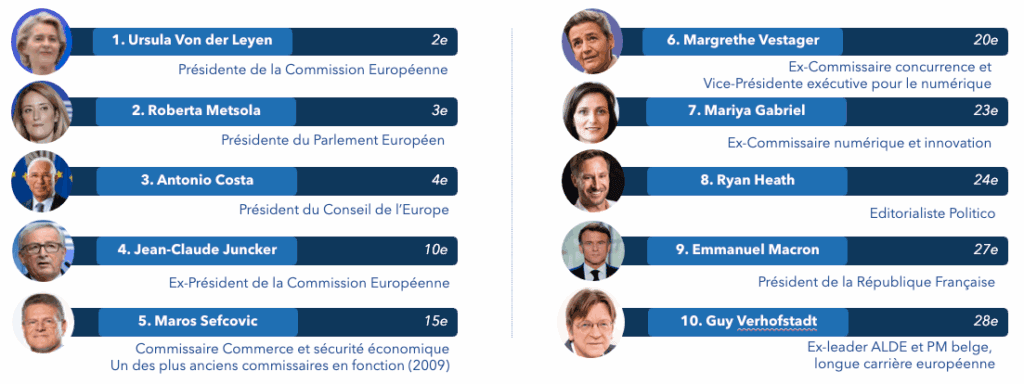
The factors of influence are clear: the position held, the visibility of the portfolio, seniority, and above all, the network — both physical and digital.
Pro-European political groups, such as Renew Europe, dominate the bubble. Conversely, the far right, more Eurosceptic, remains marginalized on European networks.
Lobbies, media, and geography of influence
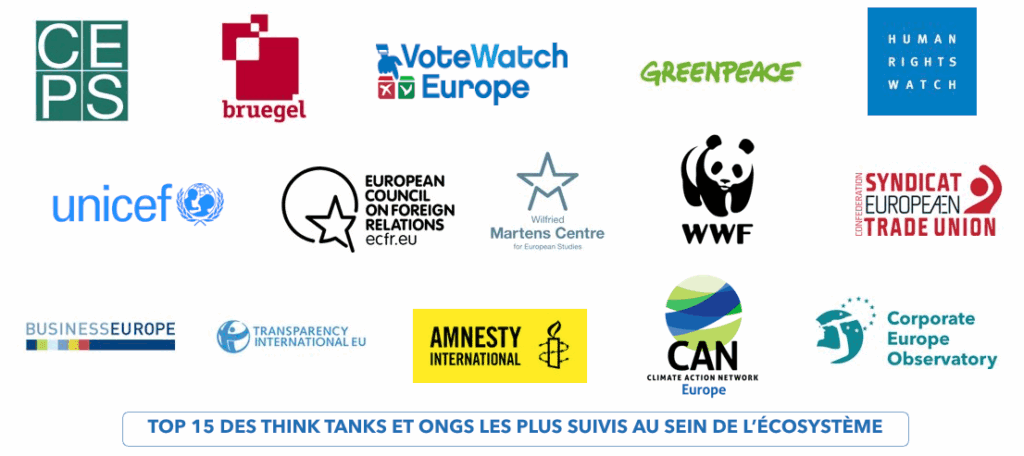
The ranking of the most visible lobbies is dominated by think tanks (Bruegel, SEPs, Wilfried Martens Center) and international NGOs (including Greenpeace). Human rights and environmental topics are strongly represented there.
On the media side, Politico stands out clearly as the reference, far ahead of Contexte, which focuses more on French-speaking audiences.
American media retain a predominant place in the circulation of European information.
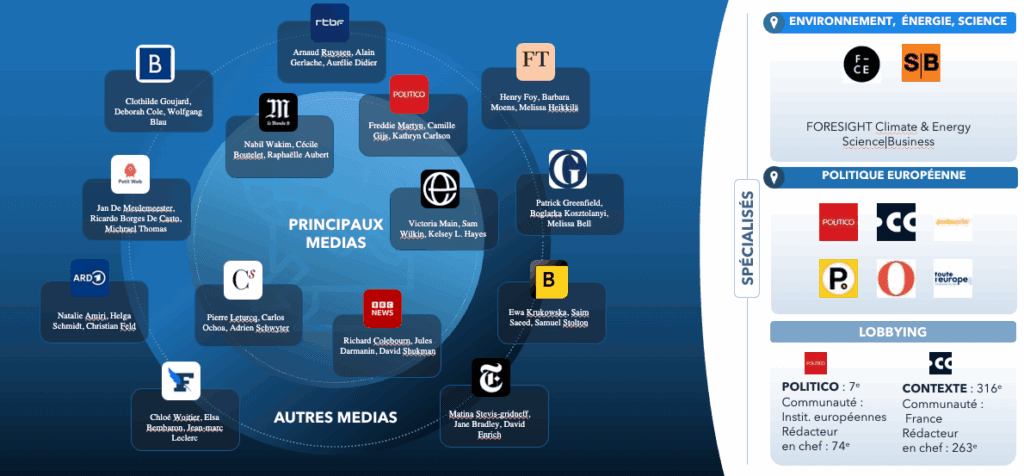
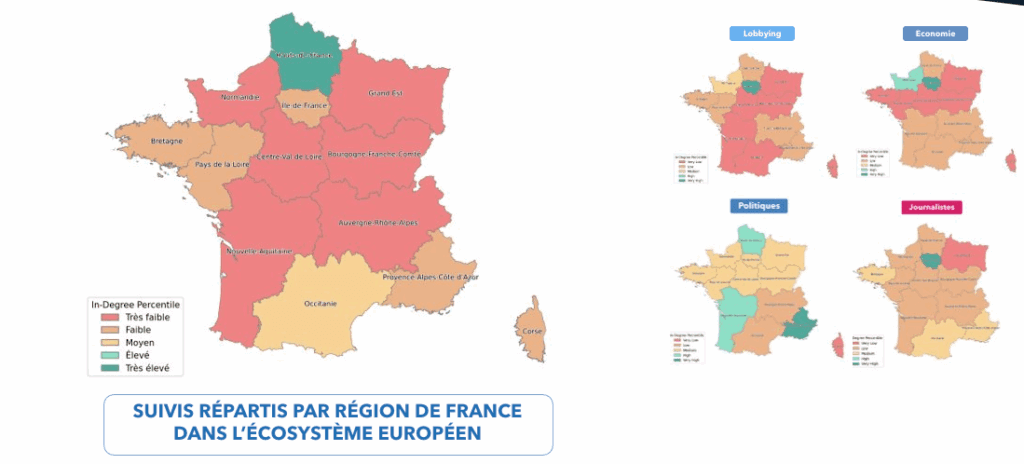
Geographically, northern France emerges as a key zone of influence, at the crossroads of Brussels, Paris, and Strasbourg. The EU’s founding countries still dominate the space, while the United Kingdom maintains a notable presence. The United States represents about 15% of total presence, far ahead of China, Russia, or India, whose official influence remains marginal.
Leaders and companies: a notable absence
The analysis of the SBF 120 within the European bubble highlights a striking observation:
French and European leaders are almost absent from this ecosystem.
Even the highest-ranked, Alexandre Bompard (Carrefour), scores only 2 out of 100.
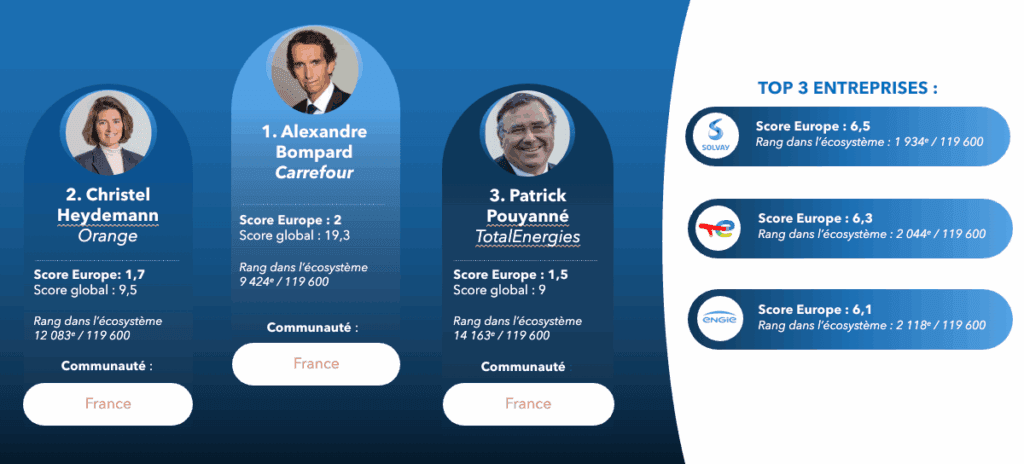
His few points come mainly from his presence in the French bubble.
European CEOs fare no better: only a few names stand out, such as Ilham Khadri (Solvay), Tim Cook (Apple), and Daniel Ek (Spotify).
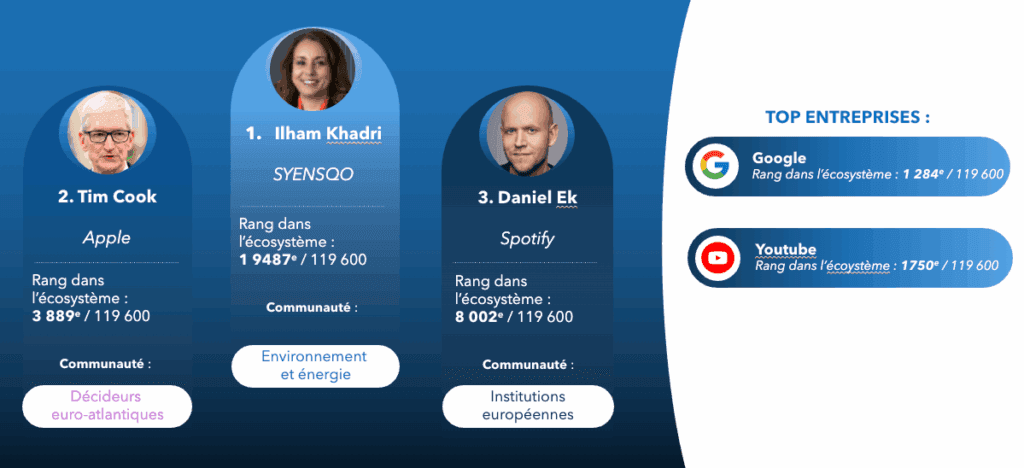
The most influential companies come from tech (YouTube, Google) and energy.
Overall, leaders prefer to let lobbies or professional federations ensure their representation with institutions.
Key takeaways
Key takeaways
This study paints the picture of a Europe of influence that remains very institutional, where dialogue is often vertical and citizen voices struggle to emerge.
Key takeaways include:
- Dichotomy between national actors and the European bubble:
The European ecosystem remains compartmentalized, with national actors seeking to influence the EU without being integrated, while the European bubble promotes dialogue yet remains closed. - Domination of multinationals and institutions:
Unlike in France, where NGOs and civil society disrupt established institutional balances (notably on TikTok), the EU remains dominated by multinationals and institutions with the financial means to run large-scale campaigns. - Major sectors well represented but unbalanced:
Sectors such as agriculture, health, and tech are well represented, with highly influential European economic lobbies.
However, industry and transport lack structure, and as Europe seeks to build its defense capacity, the sector remains encompassed by aerospace. - Topics more or less well embodied nationally:
Agriculture is dominated by certain countries (France, Ireland), Germany leads on economic issues, and tech challenges are poorly defended by countries. - The European bubble is structured nationally, not politically:
It is difficult to reach left or right-wing audiences through digital campaigns — they are split among several communities (except the far right). - Networks to prioritize:
X, Instagram, and LinkedIn are the main networks, within an old-school ecosystem where new platforms (TikTok, Bluesky) struggle to emerge. - To be influential:
Seniority, portfolio visibility, and physical and digital networking are essential (e.g., Ryan Heath of Politico). - Low official influence of foreign countries:
Except for the United States, foreign countries struggle to gain visibility within the European bubble on social media. Their disinformation attempts tend to occur at the national rather than European level. - Leaders fail to capture the attention of the European ecosystem.
But do they have the ambition or the need to? The components do not seem to be in place to wage that battle.
In short, the European bubble still operates “the old-fashioned way”: a lot of offline activity, little digital presence, and great caution in public expression. To exist in this space, one needs connections, time, and resources — or must go through already established intermediaries: media, think tanks, or interest representatives.


